Reviewed · TICKETS
Prague: Castle Tour with Local Guide and Entry Ticket
Prague Castle packs centuries of Czech history into one sprawling hilltop complex. This 150-minute guided tour gives you a clear route through St. Vitus Cathedral, the Old Royal Palace, St. George’s Basilica, and Golden Lane, rather than leaving you to guess which doorway matters.
I like two things right away: the included tram ride saves an uphill walk, and the headphones let you listen while looking around instead of crowding around a guide. Guides such as Ross, Hannah, Anna, and Tomáš have been praised for clear storytelling and useful historical context.
The main thing to consider is the group size. Small-group does not always mean tiny. One booking had 19 people, and busy days can make the cathedral harder to manage. Winter also brings cold waits and plenty of outdoor time.
In This Review
- Key points at a glance
- Starting at Malostranská and riding up to the castle
- St. Vitus Cathedral, Prague’s great Gothic centerpiece
- Vladislav Hall and the Defenestration of Prague
- St. George’s Basilica and its quieter stone interior
- Golden Lane and the small homes beneath the castle
- Why the guide matters at Prague Castle
- Group size, private tours, and the pace
- Is $61 a fair price?
- Languages, weather, and planning advice
- Who should book this Prague Castle tour?
- Should you book it?
- FAQ
- Where does the Prague Castle tour meet?
- How do I find the meeting point from the subway?
- Is transportation to Prague Castle included?
- How long does the tour last?
- What does the Prague Castle admission include?
- Are headphones provided?
- Which languages are available?
- Can I cancel the tour for a full refund?
- Can children join for free?
Key points at a glance
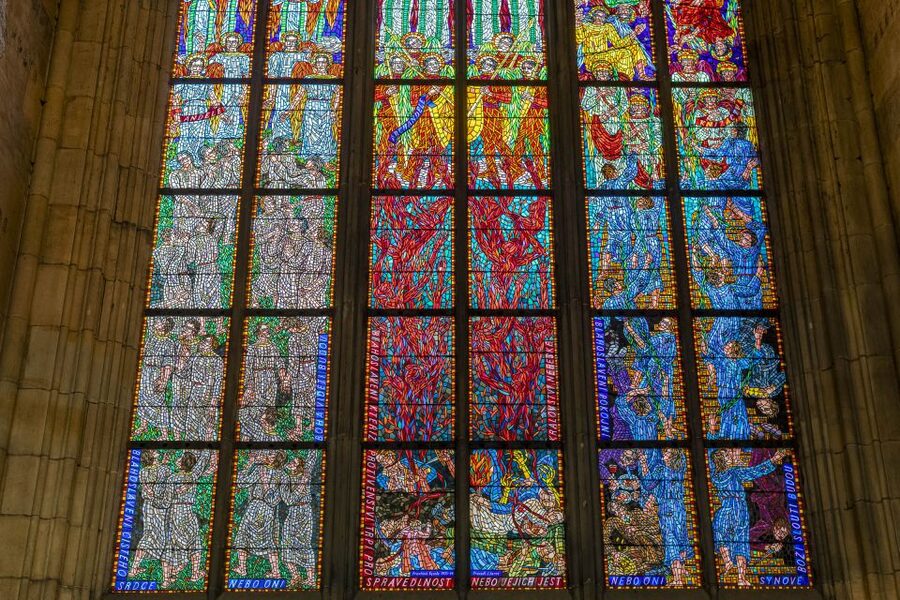
- St. Vitus Cathedral delivers the visual high point: See Mucha’s Art Nouveau stained glass, the 14th-century Last Judgment mosaic, royal tombs, and St. Wenceslas Chapel.
- The tram takes you uphill: Meet at Malostranská metro station, then ride toward the castle with your guide.
- Headphones are genuinely useful: You can hear commentary in crowded spaces and while taking a few photos.
- The Old Palace connects buildings to big events: Vladislav Hall and the Defenestration of Prague chamber bring Czech political history into focus.
- Golden Lane shows ordinary castle life: Its small cottages once housed sharpshooters, goldsmiths, and later artists including Franz Kafka.
- The $61 price buys structure as well as admission: You get transport, entry to the main paid sights, and a guide who keeps the sprawling complex manageable.
Starting at Malostranská and riding up to the castle
The meeting point is directly in front of the Malostranská metro exit, beside a small water fountain. In winter, the fountain may be covered. Look for the brown and white Meeting Point sign and a guide with an orange umbrella.
The directions are simple once you know the station layout. After taking the second escalator from the subway, go left. If you arrive by tram, get off at Malostranská, cross the street, and walk toward the metro station.
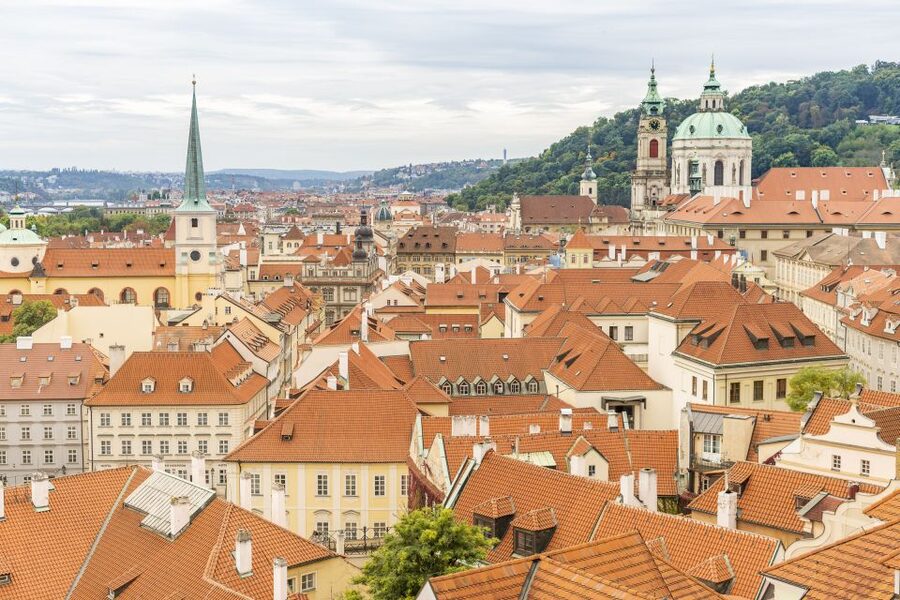
From there, the group takes a tram up to Prague Castle. That short ride is more than a minor convenience. The castle complex sits above the Lesser Town, and beginning at the upper entrance saves energy for the interiors, stairs, and cobbled paths ahead.
I like this start because you get your bearings before entering the complex. You are not simply handed a ticket and left at a gate. The guide leads the way, explains what you are about to see, and helps the group get through the entrance process.
The tour includes admission and use of the short security line. It does not mean every entrance will be instant. Security checks can still slow down, especially around holidays and in crowded periods. One winter booking reported long lines despite the advertised access, so keep your expectations practical.
A few more Prague half-days to weigh up
- Prague: Skip-the-line Castle Ticket and Optional AudioGuide
★ 4.3 · 11,121 reviews - Prague Castle 2.5-Hour Tour Including Admission Ticket
★ 4.7 · 8,927 reviews - Prague: Old Town Hall Tower Entry Ticket
★ 4.5 · 6,749 reviews
St. Vitus Cathedral, Prague’s great Gothic centerpiece
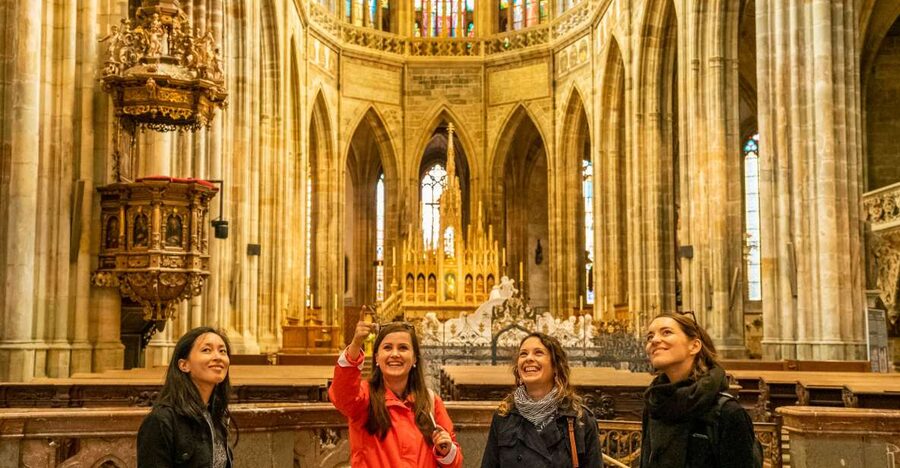
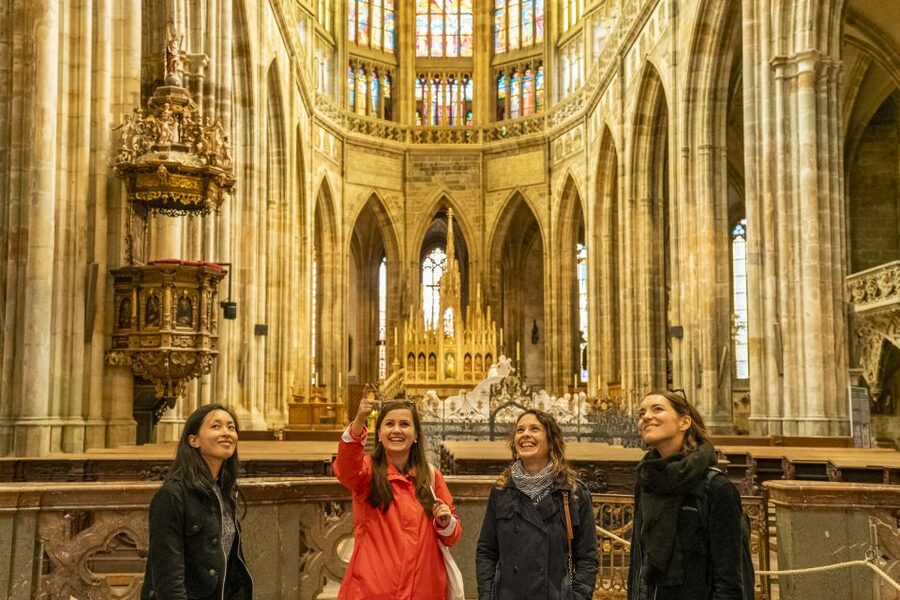
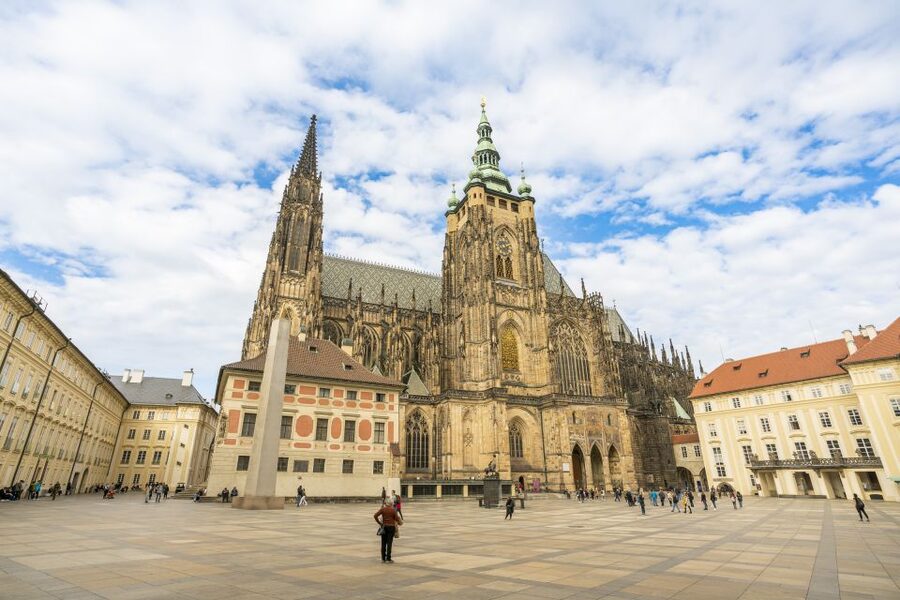
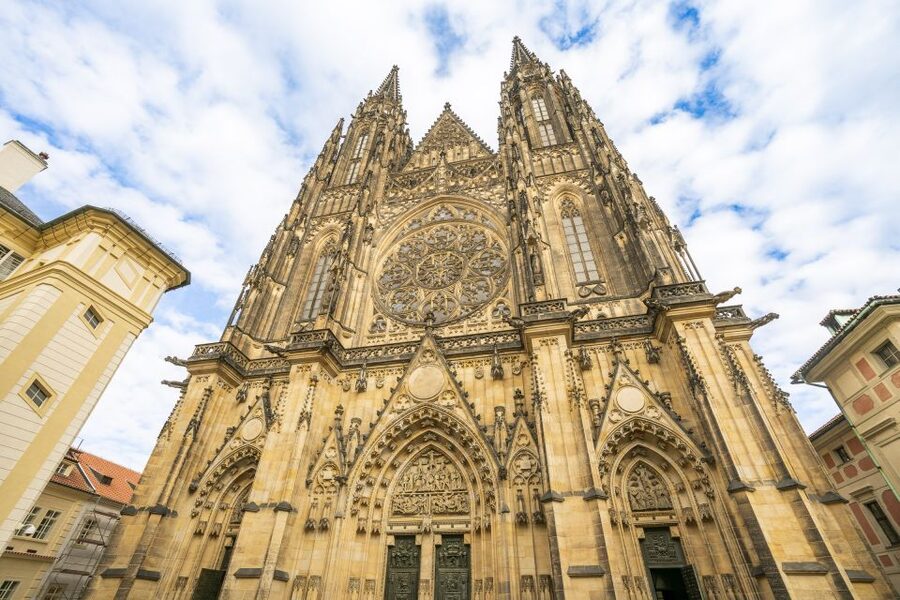
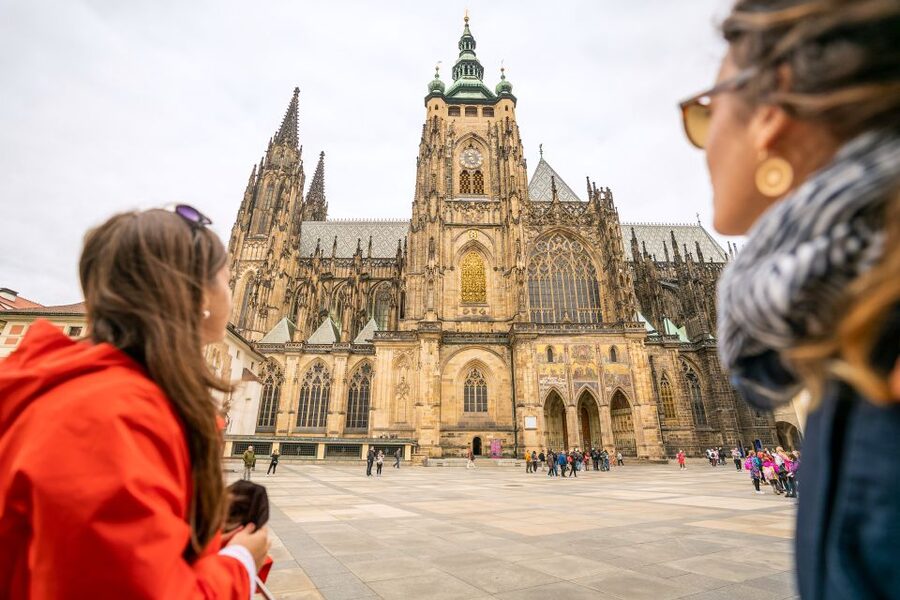
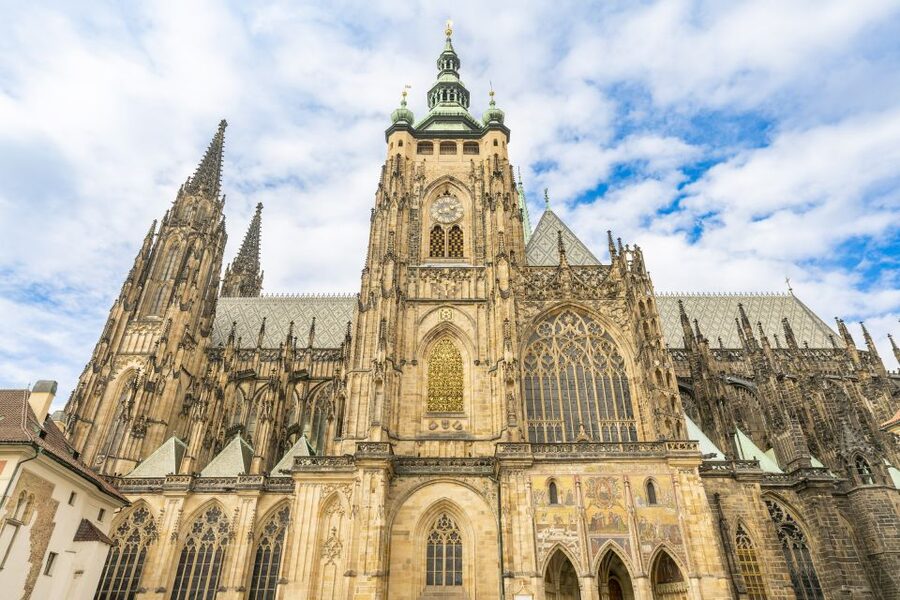
St. Vitus Cathedral is the most spectacular stop, and it deserves the largest share of your attention. From outside, look up at the gargoyles and the soaring Gothic design. Inside, the scale shifts from fortress-like stonework to colored glass, chapels, tombs, and elaborate decoration.
Your guide points out the Art Nouveau stained glass window made by Czech artist Alfons Mucha. It is a useful reminder that the cathedral is not frozen in one medieval period. Its art and furnishings reflect many centuries of Czech religious and political life.
The 14th-century mosaic of the Last Judgment is another major detail. A guide gives you a better chance of noticing work like this, especially when the cathedral is full and your attention is pulled in several directions.
The tour also covers the tombs of St. Wenceslas and Charles IV. Charles IV shaped Prague’s importance in the Middle Ages, while St. Wenceslas remains one of the key figures in Czech national tradition. The guide connects these names to the city and country, rather than treating them as isolated labels on a wall.
You will see the Baroque tomb of St. John of Nepomuk and the Chapel of St. Wenceslas. These stops add variety to the visit, moving from grand public spaces to more focused devotional interiors.
The headphones help most here. The cathedral can be noisy and crowded, and it is easy to fall behind while taking pictures. With the audio system, you can keep looking at the stained glass while still hearing the explanation.
The drawback is that cathedral crowds can affect the experience. A large group may need to pause in awkward places, and you may not always get a long, quiet look at every detail. Still, the guide’s route gives you the main works without asking you to study the building alone.
Vladislav Hall and the Defenestration of Prague
The Old Royal Palace offers a different mood. Instead of stained glass and chapels, you get political rooms, royal ceremony, and the physical setting for events that changed Europe.
The highlight is Vladislav Hall, with its huge vaulted ceiling. It was built for royal gatherings, ceremonies, and public events, and its size is striking even after the cathedral’s grandeur.
The guide also takes you to the chamber associated with the Defenestration of Prague. In 1618, Czech Protestant aristocrats threw Catholic governors of the Habsburg emperor and their secretary out of a window. The event helped trigger the Thirty Years War.
That story works particularly well on a guided tour because the room itself is not enough. Without context, it can look like another historic chamber. With an explanation of the religious and political conflict, the window becomes a memorable point in a much larger European story.
I appreciate that the tour places Prague’s buildings inside the country’s wider past. Several guides, including Ross, Janna, and Tomáš, have been praised for linking the castle to Prague and Czech history instead of reciting dates without meaning.
The palace section may feel less visually dramatic than St. Vitus. If you prefer art and architecture, the cathedral will likely be your favorite. If you enjoy political history, Vladislav Hall and the defenestration story may be the most rewarding part.
St. George’s Basilica and its quieter stone interior
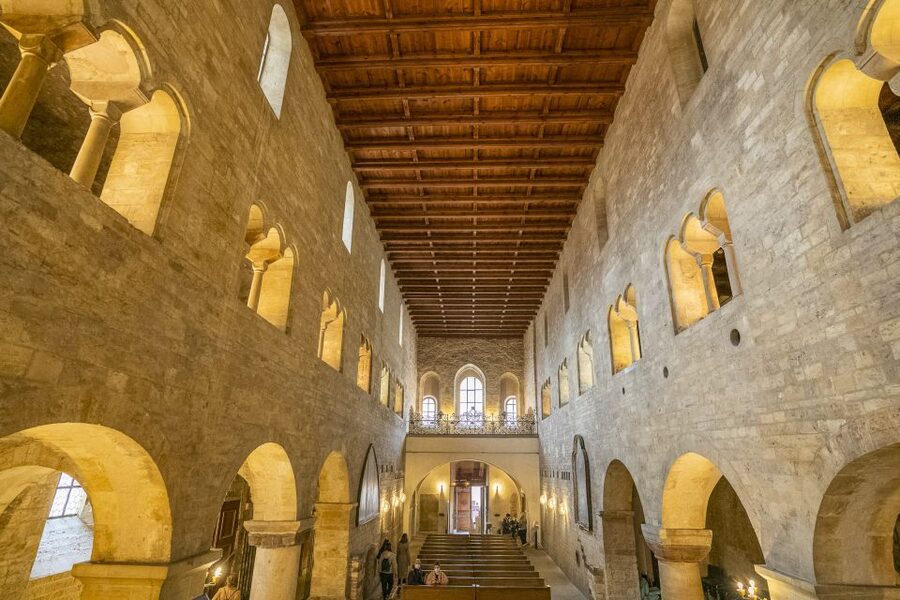
St. George’s Basilica provides a strong contrast to the cathedral. Its stone walls and simpler design feel older and more restrained, with none of the cathedral’s bright color and decorative overload.
Inside, you will see fragments of 12th-century frescoes. The details are easy to miss, particularly after the larger sights, so listen closely when the guide explains where to look.
The double staircase leads to the remains of St. Ludmila. This is a compact stop, but it adds another layer to the castle complex. The tour shows that Prague Castle is not one building with a few side rooms. It is a collection of churches, palaces, lanes, and courtyards built and altered over time.
I like the pacing here. After the busy cathedral and the imposing Old Palace, the basilica gives you a quieter visual pause. The trade-off is that the building may not impress you in the same instant way as St. Vitus. Its appeal comes from age, simplicity, and the stories attached to it.
Same city, a completely different afternoon:
- Prague: 50-Minute Sightseeing Evening Cruise
★ 4.2 · 33,780 reviews - Prague: Medieval Dinner with Unlimited Drinks
★ 4.4 · 19,847 reviews - Prague: Oldtown, Medieval Underground & Dungeon History Tour
★ 4.2 · 8,244 reviews - Prague: Vltava River Night Cruise with Buffet
★ 4.3 · 7,338 reviews
Golden Lane and the small homes beneath the castle
Golden Lane is the most intimate part of the route. Its small cottages line a narrow alley, giving you a close look at daily life beneath the royal complex.
The cottages were first built for castle sharpshooters. Later, goldsmiths worked and lived here. The reconstructed workshops and homes show how working people occupied the space in the castle’s shadow.
The lane is also linked with artists, including Franz Kafka, who lived there in a later period. That connection adds a literary footnote, but the more useful reason to visit is the change in scale. After cathedral vaults and royal halls, these tiny rooms show how modest life could be only a short walk from court ceremony.
Golden Lane can be crowded because the passage is narrow. It is not a place for a slow, private stroll during a busy time. The guide helps you understand what each cottage represents, then you can often stay longer after the formal tour if you want another look.
Why the guide matters at Prague Castle
You can visit Prague Castle without a guide, but the complex can be hard to read on your own. The ticket covers several major buildings, yet admission alone does not explain why the rooms matter or how the different periods fit together.
A good guide also keeps the route moving. The best feedback has focused on guides who were clear, warm, and able to handle questions without letting the tour lose its shape. Ross has been singled out repeatedly for historical detail, humor, and an ability to keep people engaged. Hannah, Anna, Tomáš, Janna, Marcela, Barbara, and Bianca have also been praised for clear explanations and calm group management.
That does not mean every guide will have the same style. The experience depends partly on who leads your departure and on the group around you. Some guides lean into facts and dates, while others add more personal stories and modern Czech context.
The headphones are a major practical advantage. You hear the guide while standing a few steps away, taking a photograph, or getting briefly separated by a crowd. One person did ask for a microphone and headphones on a departure where that equipment was not used, so confirm that your tour provides the listed audio gear.
Group size, private tours, and the pace
You can choose a small-group or private experience. The private option is the better fit if you want to ask many questions, set a more personal pace, or avoid the uncertainty of a larger group.
Small-group is a useful middle ground, but read the label sensibly. The group can be larger than you expect. One booking described 19 people, which is manageable in open courtyards but less comfortable inside the cathedral.
The 150-minute length is well judged for a first visit. You cover the main paid buildings without spending an entire day indoors. The pace is active, with walking, standing, and some stairs, so wear comfortable shoes.
The tour does not have to end your castle visit. After the guided portion, you can choose your own way back, walk down the steps, or use the tram. You can also stay in the area longer if you want to revisit a building or explore at your own pace.
If someone in your group has limited mobility, mention it to the guide. One guide received praise for helping people who moved more slowly. Still, the complex includes uneven surfaces, stairs, and periods of standing, so this is not a completely effortless outing.
Is $61 a fair price?
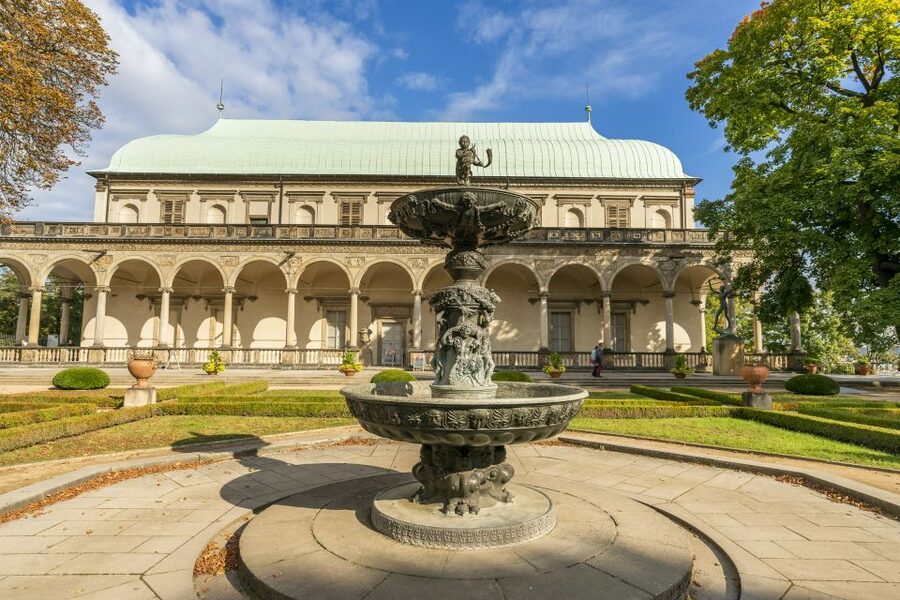
At $61 per person, the cost is reasonable if you want the main interiors and prefer a structured visit. Your price includes the tram ticket, Prague Castle admission, the local guide, commentary, headphones, and access to the short security line.
The value is not only the entry ticket. Prague Castle can feel confusing because the sights are spread across a large complex. A guide saves you from wasting time locating the right entrances and gives meaning to rooms that would otherwise be easy to pass through.
The price is less appealing if you want a slow, independent visit. You may prefer to buy entry on your own, read as you go, and return to favorite rooms without a fixed group. You also need to accept that official closures can happen at short notice, and no guide can guarantee access to every building.
Free cancellation up to 24 hours before the start and reserve-now, pay-later terms make the booking less risky. Children aged five and under go free.
Languages, weather, and planning advice
Live guides are available in English, Italian, French, Spanish, German, and Russian. Check the selected departure carefully so you book the language you want.
Bring comfortable shoes. The route includes walking between buildings, standing in historic rooms, and possible stairs. Much of the tour takes place outdoors, so cold or wet weather can change your enjoyment of the experience.
Winter can be especially demanding. One January group spent three hours in temperatures around minus 5 degrees Celsius, while another winter booking found the outdoor portions inconvenient. You will want a warm coat, gloves, and shoes suited to stone paths.
Crowds are another factor. The headphones help, and an experienced guide can keep the group together, but the cathedral and Golden Lane may still feel packed. If you want photographs without people pressing around you, consider staying after the tour or returning at another time.
Who should book this Prague Castle tour?
I would choose this tour for a first visit to Prague Castle, especially if you want the major interiors but do not want to plan the route yourself. It is also a strong choice for anyone who enjoys history and wants the Czech political stories behind the rooms.
Families can benefit from the tram and the clear route, though younger children may tire during the walking and standing. Children five and under are free, but the experience still requires attention and patience.
Independent museum-goers may find the fixed pace limiting. A private tour solves much of that problem, but it costs more than exploring alone. Also think about the season. The route is more comfortable when you can tolerate outdoor time and crowds.
Should you book it?
Book it if you want an efficient first look at Prague Castle, value clear local commentary, and like having transport and admission handled together. The strongest features are the guide’s storytelling, the headphones, and the route through the four major attractions.
Skip it if you prefer complete freedom, dislike group movement, or plan to spend several hours studying every chapel and exhibition at your own pace. For most first-time visitors, though, $61 is a fair exchange for a well-organized introduction to one of Prague’s most complicated and important sights.
FAQ
Where does the Prague Castle tour meet?
Meet directly in front of the exit of Malostranská metro station, near the small water fountain. Look for the brown and white Meeting Point sign and a guide holding an orange umbrella.
How do I find the meeting point from the subway?
After taking the second escalator from the subway, go left. The fountain may be covered during winter, so use the sign and orange umbrella as your main landmarks.
Is transportation to Prague Castle included?
Yes. The tour includes a tram ticket for the ride from the Malostranská area up to Prague Castle.
How long does the tour last?
The scheduled duration is 150 minutes.
What does the Prague Castle admission include?
Admission includes St. Vitus Cathedral, the Old Royal Palace, St. George’s Basilica, and Golden Lane.
Are headphones provided?
Yes. Headphones are included so you can hear the guide’s commentary in crowded areas.
Which languages are available?
Live guided tours are available in English, Italian, French, Spanish, German, and Russian.
Can I cancel the tour for a full refund?
Yes. You can cancel up to 24 hours in advance for a full refund.
Can children join for free?
Children aged five and under go free of charge.
Just added around Prague
- Prague Highlights 4 Hour Private Walking Tour★ 5.0 · 3 reviews
- VIP Prague Segway Tour Around Monastic Breweries★ 4.0 · 3 reviews
- Private Guided Tour from Prague to UNESCO Kutna Hora★ 5.0 · 3 reviews
- From Prague Day Unique Tour To Cesky Krumlov★ 4.5 · 3 reviews
- Cesky Krumlov: Insta-Perfect Walk with a Local★ 5.0 · 3 reviews
- Prague: WWII Tour with Local Historian SMALL GROUP★ 5.0 · 3 reviews
- Learn Traditional Czech Cooking from Authentic Family Recipes★ 5.0 · 3 reviews
- Prague Tour in Spanish★ 5.0 · 3 reviews
Tickets, compared.

Skip-the-line Castle Ticket and Optional AudioGuide
Read our review →
Prague Castle 2.5-Hour Tour Including Admission Ticket
Read our review →
Prague Castle and Lobkowicz Palace Entry Tickets
Read our review →
Entry Ticket Classical Concert at the Mirror Chapel
Read our review →
Jewish Quarter Walking Tour with Admission Tickets
Read our review →