
Reviewed · WALKING TOURS
Prague: Highlights Walking Tour to the German embassy 1989
The most moving part of this Prague walking tour comes at the end: you reach the German Embassy, where Foreign Minister Hans-Dietrich Genscher announced in 1989 that East German refugees could leave for West Germany. Along the way, Prague’s streets connect the Prague Spring, Jan Palach, the Velvet Revolution, and the fall of the Iron Curtain.
I like the strong 20th-century focus and the route through several central neighborhoods rather than a single historic quarter. I also like the chance to cross Charles Bridge and see the Lennon Wall before arriving at the embassy. The main consideration is pace: 150 minutes covers a lot, and the tour is not suitable for people with mobility impairments.
- The German Embassy balcony marks a real turning point in the 1989 refugee crisis.
- Jan Palach Square links Prague’s 1968 resistance to the later Velvet Revolution.
- Charles Bridge and John Lennon Wall add the city’s best-known sights to a serious historical walk.
- Josefov and the Old Jewish Cemetery provide an early stop in Prague’s former Jewish quarter.
- A German-speaking guide makes this especially useful for visitors interested in East and West German history.
- The $32 price is reasonable if you want a guided political history walk, not just a photo tour.
In This Review
- From the Faculty of Law to Prague’s 20th-Century Story
- Čech’s Bridge and the First Views of the City
- Josefov, the Cemetery, and the Layers of Old Prague
- Jan Palach Square and the Meaning of 1968
- The Velvet Revolution Memorial and a City in Motion
- Crossing Charles Bridge With More Than a View
- Lennon Wall and the Language of Protest
- Wenceslas Square and the National Museum
- Malostranské Square and the Final Walk to the Embassy
- The German Embassy and Genscher’s Famous Balcony
- What the $32 Price Actually Buys
- Who Will Get the Most From This Walk
- Practical Details Before You Reserve
- Should You Book the Prague 1989 Walking Tour?
- FAQ
- How long does the Prague highlights walking tour last?
- What language is the tour conducted in?
- Where does the tour meet?
- How can I reach the meeting point by public transportation?
- Does the tour include hotel pickup?
- Can I go inside the German Embassy?
- Is the tour suitable for people with mobility impairments?
- Is food or drink included?
- Can I cancel the booking?
From the Faculty of Law to Prague’s 20th-Century Story
You meet in front of the Faculty of Law of Charles University, at náměstí Curieových 7 in the Old Town. Staroměstská metro station is about 550 meters away, or tram 17 stops at Pravnicka Fakulta. An optional hotel pickup is available in Prague 1, 2, or 3, and near the Můstek metro station.
The location sets the tone. You are not beginning at a generic tourist office, but near one of Prague’s major academic institutions. The first part of the walk moves through places tied to civic life, protest, occupation, and political change.
This is a walking tour first, and a sightseeing tour second. You will see famous Prague views, but the guide’s job is to explain why particular squares, bridges, and buildings mattered during the tense decades before 1989.
The experience is offered in German, with a private group option. David Klaus Travel Manager Service Prag is the provider, and David is specifically named in one booking as a guide who answered questions thoroughly. If having David is important to you, confirm the guide when booking rather than assuming he leads every departure.
Čech’s Bridge and the First Views of the City
The route includes a short stop at Čech’s Bridge, with time for photographs and views along the river. This is a useful opening because it gives you a sense of Prague’s geography before the walk turns toward the city’s historic quarters.
You can expect about 10 minutes here. That is enough for a brief explanation and photographs, but not a long architectural study. The bridge works best as a visual introduction to the riverfront and the central districts you will cross later.
If you are hoping for a slow morning of photography, this will feel quick. If you want the guide to get moving and connect the city to its political story, the short stop makes sense.
More Prague highlights tours:
- Prague: 50-Minute Sightseeing Evening Cruise
★ 4.2 · 33,780 reviews - Prague: Panoramic Vltava River Cruise
★ 4.1 · 7,311 reviews - Prague: Sightseeing Dinner Cruise on Open-Top Glass Boat
★ 4.4 · 6,314 reviews
Josefov, the Cemetery, and the Layers of Old Prague
The walk continues into Josefov, Prague’s former Jewish quarter, with a photo stop at the Old Jewish Cemetery. The cemetery is one of the most memorable places in this part of town, even when viewed as part of a brief exterior stop.
You will spend roughly 10 minutes at the cemetery and another 10 minutes in Josefov. This is not a full Jewish Museum visit, and admission to interior sites is not part of the experience. Instead, you get orientation to the neighborhood before the tour moves toward the modern political history of Prague.
I appreciate this change of subject. Prague’s story is not only about communism and 1989. Josefov reminds you that the city’s past includes much older and more painful chapters. The short visit also keeps the tour from becoming a single-issue march through recent history.
Jan Palach Square and the Meaning of 1968
At Jan Palach Square, the guide turns to one of the defining figures of the Prague Spring period. Jan Palach was a student at the Faculty of Philosophy who became a symbol of resistance after the Soviet-led invasion ended Czechoslovakia’s attempt at political reform in 1968.
The stop lasts about 10 minutes and includes a guided explanation and time for photographs. This is one of the places where the tour’s German-language format can be especially helpful. The story connects Czech resistance with the wider division of Central Europe, rather than treating Prague’s events as isolated local history.
You should not expect a museum presentation or a long lecture. The value is in standing in the public space where the guide can connect Palach’s fate with the later demonstrations that challenged communist rule.
For me, this is one of the most important stops. It gives emotional weight to the final visit at the German Embassy. The events of 1989 did not appear from nowhere. They grew out of earlier resistance, public grief, and years of pressure.
The Velvet Revolution Memorial and a City in Motion
The tour includes a 15-minute stop at the Velvet Revolution Memorial. The memorial recalls the peaceful demonstrations that helped bring down communist rule in Czechoslovakia in late 1989.
This stop is short enough to keep the walk moving, but long enough for the guide to explain the basic sequence of events. You will hear about the rise and fall of communism in Central Europe and the political changes that followed.
The term Velvet Revolution refers to the largely nonviolent nature of the change. That does not mean the period was simple or calm. The memorial gives the guide a place to explain how students, citizens, and public figures became involved in a movement that quickly spread through Prague.
I like the way this stop sits between Jan Palach Square and the later embassy story. It creates a clear line: the unresolved memory of 1968, public action in 1989, and the refugee crisis that helped force international attention on the divided continent.
More walking tours in Prague:
- Prague: 3-Hour Walking Tour of Old Town & Prague Castle
★ 4.7 · 5,696 reviews - Prague: Ghost Walking Tour Where Legends Come To Life
★ 4.4 · 5,253 reviews - Prague: Jewish Quarter Walking Tour with Admission Tickets
★ 4.7 · 3,729 reviews - Prague Guided Walking Tour and Cruise with Authentic Czech Lunch
★ 5.0 · 3,627 reviews
Crossing Charles Bridge With More Than a View
Charles Bridge receives about 15 minutes, including a guided walk, sightseeing, and photographs. You will cross one of Prague’s most famous landmarks while the guide keeps the focus on the city’s political and social story.
The bridge is often crowded, so you may need to share the view with plenty of other people. The short time is not designed for lingering beside every statue or taking a long sequence of photographs. Still, the crossing is a smart part of the route because it links Old Town with Lesser Town and gives you one of Prague’s essential experiences.
The bridge also helps you understand the physical shape of the city. You move from the Old Town side toward Malá Strana, with the river and historic buildings around you. Even with the history-heavy focus, this is a classic Prague walk.
Wear shoes you can walk in comfortably. The tour lasts two and a half hours, and the route includes several districts, a bridge crossing, and uneven urban surfaces. The activity is specifically not suitable for people with mobility impairments.
Lennon Wall and the Language of Protest
At John Lennon Wall, you have about 10 minutes for a guided visit and photographs. The wall is covered with changing graffiti, messages, and images linked to peace, freedom, and opposition to authority.
This stop brings a different mood. Jan Palach Square and the Velvet Revolution Memorial deal with named events and public sacrifice. Lennon Wall shows how political feeling also appeared through music, art, and informal expression.
Do not expect a quiet, untouched monument. Its changing appearance is part of the point. The wall is best understood as a living place of homage rather than a fixed museum display.
I like this stop because it prevents the tour from becoming a sequence of official memorials. It shows how visitors and residents encounter Prague’s political past through public art, not only through statues and plaques.
Wenceslas Square and the National Museum
The route then reaches Wenceslas Square, where you spend about 15 minutes on a guided visit and sightseeing. The square has long been one of Prague’s main public spaces, and its size helps explain why it became important during major political demonstrations.
The square is also one of the clearest places to discuss the Velvet Revolution. Large gatherings could form here, and the setting made political change visible to the whole city.
The tour includes a short photo stop at the Prague National Museum, listed at about five minutes. You should see the building from the outside rather than plan on a museum visit during this tour. The stop works as a landmark and a backdrop for the political story, not as an indoor cultural visit.
This portion of the walk can feel brisk. You are moving from Malá Strana toward the central square, and the guide has to balance sightseeing with the larger history. I would not book this experience if your main goal is detailed architecture at every stop. I would book it if you want landmarks explained through the conflicts that shaped modern Prague.
Malostranské Square and the Final Walk to the Embassy
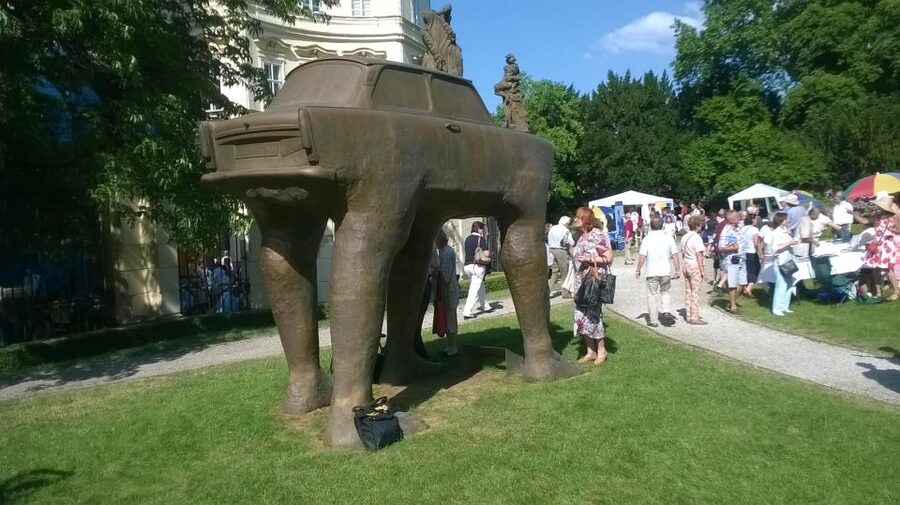
The group reaches Malostranské Square for a short sightseeing stop of about five minutes. This is in Lesser Town, near the final section of the route.
From here, the tour continues on foot for roughly 10 minutes to the German Embassy. The finish at Malostranské náměstí makes sense geographically, since the embassy is in the Lesser Town area. It also avoids ending at a distant attraction after the main story has reached its final chapter.
The last walk is not simply a transfer. The guide can use it to explain how East German citizens reached Prague in 1989 and why the West German Embassy became central to the unfolding crisis.
The German Embassy and Genscher’s Famous Balcony
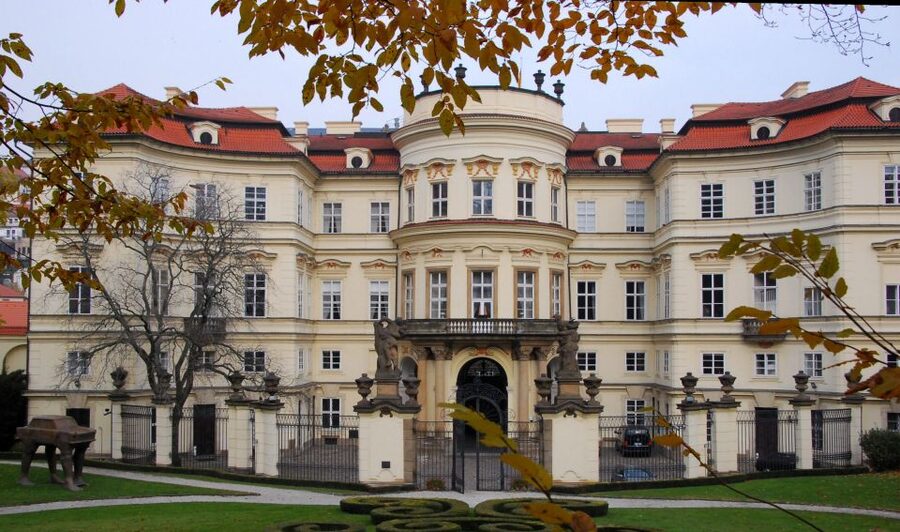
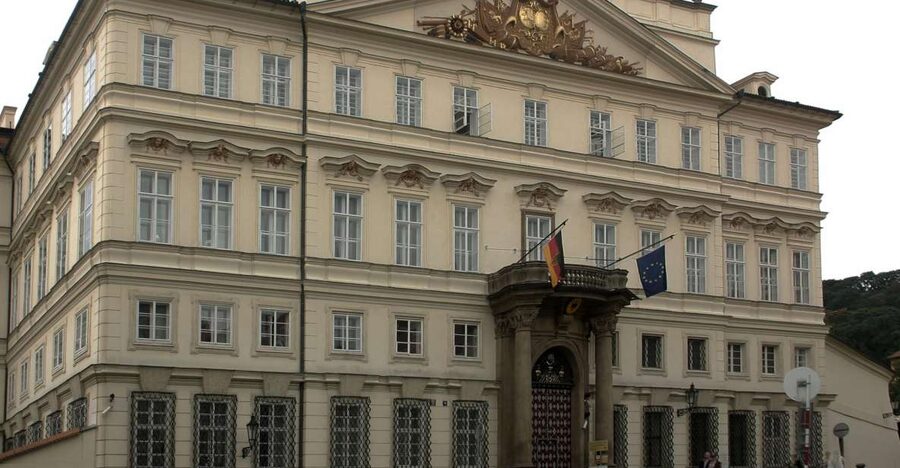
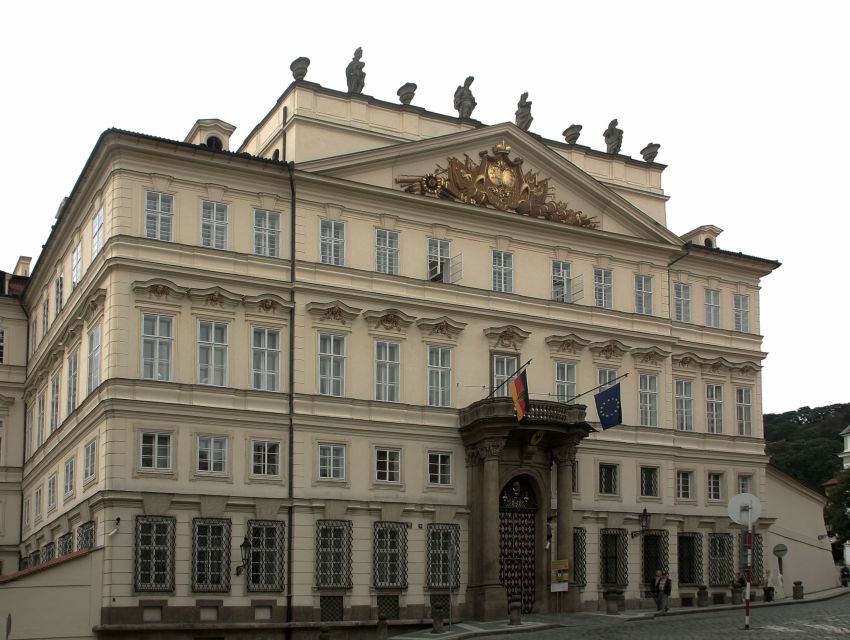
The German Embassy is the tour’s main destination. In 1989, East German citizens fled through Poland and Hungary and gathered at the West German Embassy in Prague, hoping to reach the West. The grounds filled with refugees, and the situation became an international crisis.
From outside, you will see the German Embassy and the balcony associated with Hans-Dietrich Genscher, the German Federal Republic’s foreign minister. His announcement from the balcony brought the news that the refugees could leave for West Germany.
The stop lasts about 10 minutes and includes photographs and sightseeing. The embassy interior is not open to the public, so the experience depends on the exterior view and the guide’s explanation. That limitation is important. You are not touring the building or standing inside the garden as part of a public visit.
Still, the location has unusual emotional force. One verified booking described a return to the place after 36 years, recalling a family member who had been beside Genscher on the balcony when the news was announced. That personal connection shows why this stop can feel far more powerful than a standard photo opportunity.
If you have a family link to the events of 1989, or a strong interest in German reunification, this final stop may be worth the price by itself. If you expect access to the embassy grounds or interior rooms, you will be disappointed.
What the $32 Price Actually Buys
At $32 per person, the tour is priced as an accessible guided walk rather than a full-day private sightseeing service. You are paying for 150 minutes with a licensed German-speaking guide, a planned route through several central neighborhoods, and historical interpretation at places that are easy to pass without context.
The value is strongest if you want the guide to connect separate events. On your own, you can visit Charles Bridge, Lennon Wall, Wenceslas Square, and the National Museum. What is harder to recreate is the thread linking Jan Palach, the Velvet Revolution, the division of Germany, and the embassy refugee crisis.
The price does not include food, drinks, hotel drop-off, or entry to indoor attractions. Since the route relies on public streets and exterior sights, there are no major admission costs built into the experience.
A private group is available. That option should appeal to families, colleagues, or German-speaking groups who want to ask questions freely or keep the pace more personal. The standard price is easier to justify for people who care about the political history, not just the landmarks.
Who Will Get the Most From This Walk
I would recommend this tour to you if you:
- Want a German-speaking guide in Prague
- Care about the Prague Spring, Jan Palach, the Velvet Revolution, or the Iron Curtain
- Prefer a walking route that combines famous sights with modern history
- Want to see the German Embassy from outside and understand its role in 1989
- Are comfortable walking for 150 minutes through central Prague
- Prefer a small or private group and want to ask questions
I would choose another experience if you want extensive time inside museums, a relaxed photography walk, or a tour designed for limited mobility. The Old Jewish Cemetery and National Museum are exterior or brief stops, not full visits.
The route also moves quickly between districts. You should arrive ready to walk, listen, and keep up rather than expect long breaks at each sight.
Practical Details Before You Reserve
The meeting point is in front of the Faculty of Law, Charles University, at nám. Curieových 7, 116 40 Old Town. From Staroměstská metro station, walk about 550 meters. Tram 17 stops at Pravnicka Fakulta.
Hotel pickup is optional in Prague 1, 2, or 3, or near the Můstek metro station. Hotel drop-off is not included.
The live guide speaks German. The provider is David Klaus Travel Manager Service Prag, and the experience has an overall rating of 4.8 from seven ratings. The strongest praise centers on the informative guidance, clear answers to questions, and the emotional significance of reaching the embassy balcony.
You can cancel up to 24 hours before the activity for a full refund, and you can reserve now while paying later. Check the available starting times because departures vary.
Should You Book the Prague 1989 Walking Tour?
Book it if you want Prague’s famous sights tied to the political struggles of the 20th century. The German Embassy gives the walk a distinctive purpose, while Jan Palach Square, the Velvet Revolution Memorial, Charles Bridge, and Lennon Wall keep the route varied.
At $32, I see good value for a focused two-and-a-half-hour tour with a licensed German-speaking guide. Just keep your expectations clear: the embassy is viewed from outside, the museum and cemetery are not full indoor visits, and the route is not suitable for people with mobility impairments.
For German speakers interested in the end of East Germany and the road to reunification, this is an especially meaningful choice. For everyone else, it works best as a modern-history walk that adds serious context to Prague’s most familiar streets.
FAQ
How long does the Prague highlights walking tour last?
The tour lasts 150 minutes, or two and a half hours.
What language is the tour conducted in?
The live guide speaks German.
Where does the tour meet?
The main meeting point is in front of the Faculty of Law, Charles University, at nám. Curieových 7 in Prague’s Old Town.
How can I reach the meeting point by public transportation?
You can get off at Staroměstská metro station and walk about 550 meters. Tram number 17 stops at Pravnicka Fakulta, near the meeting point.
Does the tour include hotel pickup?
Optional pickup is available from hotels in Prague 1, 2, or 3, or from the city center near the Můstek metro station. Hotel drop-off is not included.
Can I go inside the German Embassy?
No. The embassy interior is not open to the public. The tour views the building and the balcony from outside.
Is the tour suitable for people with mobility impairments?
No. The activity is listed as unsuitable for people with mobility impairments.
Is food or drink included?
No. Food and drinks are not included.
Can I cancel the booking?
Yes. You can cancel up to 24 hours in advance for a full refund. You can also reserve now and pay later.
Just added around Prague
- Prague Highlights 4 Hour Private Walking Tour★ 5.0 · 3 reviews
- VIP Prague Segway Tour Around Monastic Breweries★ 4.0 · 3 reviews
- Private Guided Tour from Prague to UNESCO Kutna Hora★ 5.0 · 3 reviews
- From Prague Day Unique Tour To Cesky Krumlov★ 4.5 · 3 reviews
- Cesky Krumlov: Insta-Perfect Walk with a Local★ 5.0 · 3 reviews
- Prague: WWII Tour with Local Historian SMALL GROUP★ 5.0 · 3 reviews
- Learn Traditional Czech Cooking from Authentic Family Recipes★ 5.0 · 3 reviews
- Prague Tour in Spanish★ 5.0 · 3 reviews
Walking Tours, compared.
3-Hour Walking Tour of Old Town & Prague Castle
Read our review →
Ghost Walking Tour Where Legends Come To Life
Read our review →
Jewish Quarter Walking Tour with Admission Tickets
Read our review →
Prague Guided Walking Tour and Cruise with Authentic Czech Lunch
Read our review →
Old Town and Jewish Quarter Guided Walking Tour
Read our review →
Prague Ghost and Legend of Old Town Walking Tour
Read our review →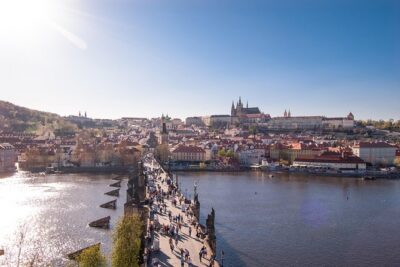
Prague 3-hour Afternoon Walking Tour including Prague Castle
Read our review →
Ghosts and Legends Nighttime Guided Walking Tour
Read our review →Browse the lists this tour appears in