
Reviewed · WALKING TOURS
Private Prague Art Nouveau and Cubism Walking Tour
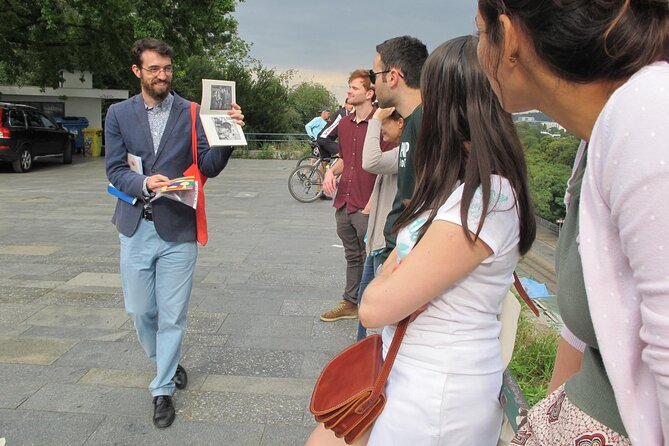
Prague’s Gothic towers get much of the attention, but this private walk shows you the city’s bold early-20th-century side. You’ll spot gingko leaves, curling signs, ornate lamps, and geometric Cubist forms while learning how Czech artists looked toward modern Europe.
I like the private format, which lets your guide adjust the pace and explain details you might miss alone. I also like the mix of grand public buildings and everyday interiors, including Café Imperial and Lucerna Arcade. The drawback is simple: three hours on foot is a lot, and the tour is not suited to anyone with limited mobility.
In This Review
- Key points at a glance
- Why Prague’s Art Nouveau deserves three hours
- Starting at the House of the Black Madonna
- Obecni Dum and Prague’s civic pride
- K+K Hotel Central and Café Imperial
- The Czechoslovak Legion Bank and Cubist angles
- Prague Main Train Station’s Art Nouveau dome
- Wenceslas Square from Art Nouveau to Art Deco
- Lucerna Arcade and the Havel connection
- The upside-down Wenceslas statue
- How the private format affects the experience
- Is $396.46 good value for up to 10 people?
- Timing, meeting point, and practical planning
- Who should book this Prague architecture walk?
- Should you book the Art Nouveau and Cubism tour?
- FAQ
- How long is the Prague Art Nouveau and Cubism tour?
- How many people can join the private tour?
- Is the tour offered in English?
- Where does the tour meet?
- Is hotel pickup included?
- What buildings are visited?
- Are food and drinks included?
- Can I cancel for a full refund?
Key points at a glance
- See Prague’s rare Cubist architecture: The House of the Black Madonna and Czechoslovak Legion Bank show how sharply Czech design broke from older styles.
- Read Art Nouveau details properly: Your guide points out curved lettering, floral shapes, oriental influences, and decorative interiors.
- Enter Prague’s modern era: Obecni Dum, Wenceslas Square, and the main train station reveal Czech confidence at the turn of the 20th century.
- Meet the city’s more playful side: The upside-down statue of King Wenceslas riding a dead horse adds a modern political and historical edge.
- Travel privately: Only your group participates, with space for up to 10 people and morning or afternoon departure options.
- Expect serious walking: The route takes roughly three hours, so wear comfortable shoes and plan for a steady pace.
Why Prague’s Art Nouveau deserves three hours
This tour works because it changes the way you look at central Prague. Instead of treating each building as a pretty façade, you learn to read its lamps, lettering, tiles, windows, and plant shapes as clues to a particular period.
Art Nouveau arrived with a taste for flowing lines and natural forms. Look for flowers, leaves, curved ironwork, colored glass, and signs whose lettering bends like the posters and magazines of the day. The style also drew on influences from outside Europe, including the gingko biloba leaves mentioned along the route.
Cubism is a different story. In Prague, it developed into a striking architectural language, with angular surfaces and faceted shapes that can seem almost crystalline. The result is not always easy to spot at first. A good guide helps you see why a building feels unusual, even when you cannot immediately name the reason.
The wider setting matters, too. Around 1900, Prague was entering a new period of confidence. Czech artists, architects, bankers, and civic leaders wanted a place in modern European culture. The buildings on this walk show that ambition in public halls, banks, hotels, cafés, shops, and railway spaces.
More walking tours in Prague:
- Prague: 3-Hour Walking Tour of Old Town & Prague Castle
★ 4.7 · 5,696 reviews - Prague: Ghost Walking Tour Where Legends Come To Life
★ 4.4 · 5,253 reviews - Prague: Jewish Quarter Walking Tour with Admission Tickets
★ 4.7 · 3,729 reviews
Starting at the House of the Black Madonna
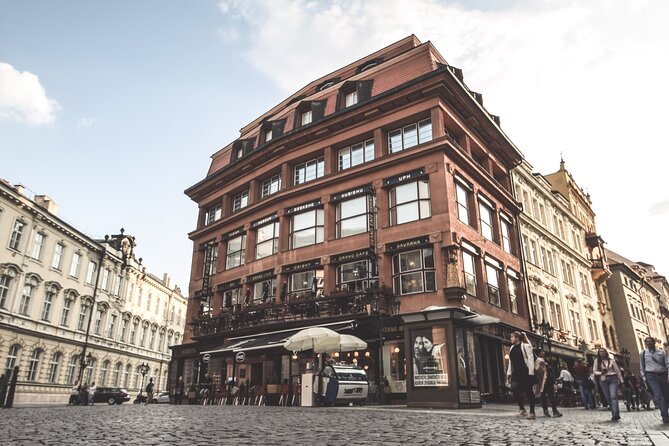
The first stop is the House of the Black Madonna, a distinctive Cubist building in central Prague. You have about 10 minutes here, enough to examine its bold exterior and hear why it matters in the story of Czech design.
The name refers to a statue of the Black Madonna associated with the building. The important point for this tour is its unusual Cubist form. Rather than relying on the rounded decoration common to Art Nouveau, Cubist architecture uses sharp angles and broken planes.
This is a useful first stop because it gives you a visual comparison for the rest of the morning or afternoon. Once you have seen the building’s angular style, you can better separate Cubism from the softer curves of Art Nouveau.
Admission is free at the listed stops, but the short visit means you should not expect a long interior tour here. The value comes from the explanation and the visual introduction.
Obecni Dum and Prague’s civic pride
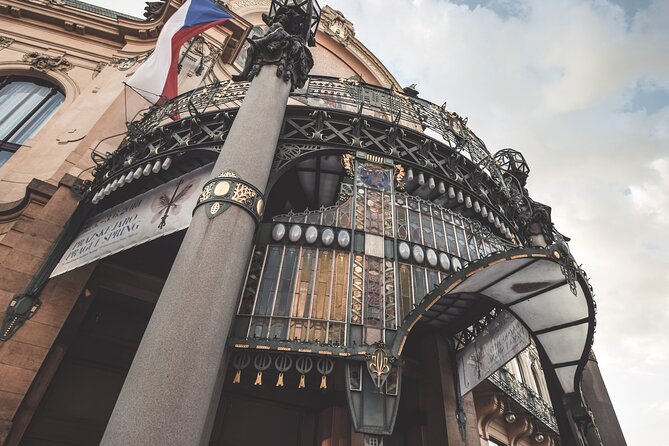
Next comes Obecni Dum, one of Prague’s best-known Art Nouveau buildings. You have about 15 minutes to discuss its design, and this is likely to be one of the tour’s main architectural highlights.
Obecni Dum shows Art Nouveau at its grandest and most public. It was built to make an impression, with decoration that links art, national identity, and civic ambition. Your guide can help you separate the building’s overall splendour from the specific style markers: plant motifs, curving lines, decorative surfaces, and carefully designed details.
I find this stop especially useful because it puts the art movement into a Czech setting. Art Nouveau was not only a European fashion imported into Prague. It became part of the city’s own cultural voice at a time when Czech national identity was gaining force.
The visit is brief, so you will want to stay alert rather than simply admire the building from a distance. Look up and around. The small features are often the very things that make the style readable.
K+K Hotel Central and Café Imperial
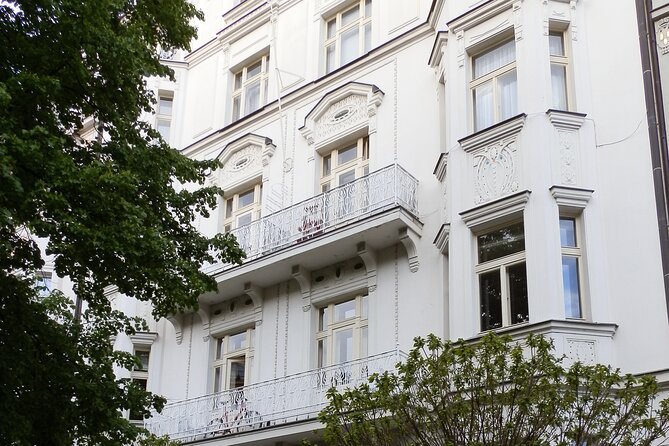
The K+K Hotel Central Prague is described as Prague’s first Art Nouveau building. You have about 10 minutes here, with attention to its exterior and its place in the city’s architectural development.
A hotel is a fitting example. Art Nouveau was not limited to museums or official buildings. It appeared in places where people ate, slept, met, conducted business, and presented themselves to the world. The hotel helps show how the new style entered daily urban life.
The tour then moves to Café Imperial, with about five minutes for its distinctive Art Nouveau interior. This is a short stop, but it gives you a chance to see how the style worked indoors. Decorative design could shape the mood of a café just as much as it shaped a public façade.
Do not count on a full meal or extended café visit during the tour. Food and drinks are not included, so treat this as a design stop. If you want to sit down afterward, you can return on your own time.
A few more Prague half-days to weigh up
- Prague Old Town: Private Tour
★ 5.0 · 1,223 reviews - Prague Airport Private Arrival Transfer
★ 4.5 · 991 reviews - Prague Airport Private Departure Transfer
★ 4.5 · 780 reviews - Discover Prague Private Tour – 3 hours
★ 5.0 · 705 reviews
The Czechoslovak Legion Bank and Cubist angles
The Czechoslovak Legion Bank brings the tour back to Cubism. You have about 10 minutes to look at its architecture and interior, which are dedicated to the Czechoslovak Legion of the First World War.
This stop adds a political and national layer to the design story. A bank is more than a place for financial business here. Its appearance connects architecture with the memory of the legion and with the formation of modern Czechoslovak identity.
The angular style can feel more severe than Art Nouveau. That contrast is one of the tour’s strengths. You do not just see a series of attractive buildings. You see two competing ideas of modernity: one flowing and decorative, the other sharp and fractured.
Because this is a walking tour rather than a museum visit, the amount of time inside each building may be limited. Your guide’s interpretation matters. A private group makes it easier to pause for a question or ask for a clearer comparison between the two styles.
Prague Main Train Station’s Art Nouveau dome
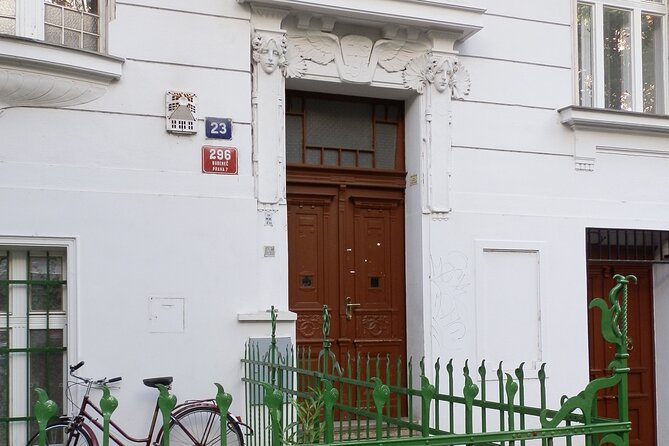
Prague Main Train Station is another important stop, with about 15 minutes to discuss its magnificent Art Nouveau dome and interior.
Railway stations were public stages for a modern age. They brought people, goods, news, and new ideas into the city. An ornate station interior could signal that Prague belonged in the same modern world as other European capitals.
The dome gives you a chance to look at Art Nouveau on a large scale. Instead of focusing only on a doorway or sign, you can see how the style shapes a major public space. This is also a good point to consider how architecture affected ordinary movement through the city. People passed through these spaces on their way to work, home, war, business, and holidays.
The stop lasts longer than some of the smaller visits, but it remains part of a route with many changes of scene. If you prefer a slow museum-style visit, the pace may feel brisk. If you like connecting several sites across the city, the sequence works well.
Wenceslas Square from Art Nouveau to Art Deco
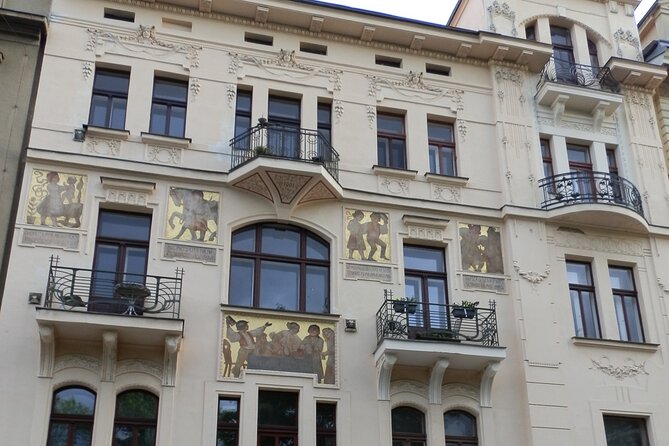
The tour reaches Wenceslas Square for about 15 minutes. Here, the discussion broadens beyond one building to the architectural character of the square, including both Art Nouveau and Art Deco influences.
This is where the city’s changing design language becomes easier to understand. Art Nouveau was not a fixed look that appeared overnight and then disappeared. Styles shifted, overlapped, and responded to new tastes. Wenceslas Square lets your guide place the buildings along that timeline.
The square also carries strong importance in Czech public life, and the tour connects its architecture with the country’s national revival. That gives the buildings a larger purpose. You are not only studying façades. You are looking at how a city presents its identity in a central public space.
The route is near public transportation, which helps if you need to continue sightseeing afterward. Still, the tour is not designed as a hop-on, hop-off outing. You will cover the route on foot and should allow time for the walk between stops.
Lucerna Arcade and the Havel connection
Lucerna Arcade offers about 10 minutes to view what is described as one of Prague’s most beautiful Art Nouveau arcades. The interior gives you another look at how decorative design shaped commercial and social spaces.
Arcades are particularly useful for understanding this period. They were not simply passages between streets. Their interiors could combine shops, entertainment, cafés, signs, lighting, and ornament in one carefully planned environment.
The tour also includes the Lucerna Bar, once owned by the family of Václav Havel. This detail adds a personal and political connection to the route. It links the turn-of-the-century building world with one of the best-known families in modern Czech public life.
The Lucerna section is a good reminder that architecture is not sealed off from people. Buildings gather businesses, families, artists, politicians, and customers over time. Your guide can connect those layers without turning the tour into a long list of dates.
The upside-down Wenceslas statue
The final stop is the contemporary sculpture of King Wenceslas riding an upside-down dead horse. You have about 10 minutes to discuss its symbolism in relation to Czech history and the national revival.
This work shifts the tour from historic architecture to modern commentary. Its humor is dark and deliberately awkward. It asks you to reconsider a familiar national figure and the way public symbols are used.
Ending here is smart because it keeps the tour from becoming a sealed lesson about 1900. Prague’s relationship with its past remains active and sometimes irreverent. The sculpture gives you a final way to think about national identity, memory, and the distance between official stories and modern artistic reactions.
This is also a strong stop for anyone who likes public art with an argument behind it. If you prefer only traditional architecture, it may feel like a side trip. If you enjoy seeing how a city talks back to its own history, it rounds out the walk nicely.
How the private format affects the experience
The tour is private for your group, with up to 10 people. That matters more here than it would on a simple sightseeing loop because the subject depends on observation and questions.
You can ask why one façade is Art Nouveau while another is Cubist. You can request more context about the Czech national revival, the Czechoslovak Legion, Václav Havel’s family, or the modern sculpture. A private guide can also spend more time on the subjects that interest you most, though the exact pace depends on your guide and group.
The guides named in the available information include Robert Wesley and Bonita. Robert Wesley is Czech-born and has a Nigerian father, a personal detail that can add another layer to his stories about Czech identity and culture. Bonita brings together art, architecture, history, and culture in a way suited to this cross-disciplinary route.
You should still be realistic about the format. The tour includes many stops, and most visits are short. It is designed to build a connected picture of Prague, not to provide a long interior study of every building.
Is $396.46 good value for up to 10 people?
The listed price is $396.46 per group, not per person, for up to 10 people. A full group would bring the cost to roughly $40 per person, before any food or drinks. A couple or small family will pay more per person, but you are buying a private guide rather than joining a large group.
The price makes the most sense if you have several people who care about architecture, design, or Czech history. It also suits a family or group with mixed interests because a private guide can explain the subject in plain terms instead of assuming everyone already knows the styles.
I would compare it with the cost of a standard group walking tour, but price alone does not tell the whole story. The route includes a specialist subject, multiple buildings, a historian guide, and a private setting. You are also getting help with interpretation, which is the hardest part of seeing Art Nouveau and Cubism on your own.
If you are happy simply photographing famous landmarks, this may be more than you need. If you want to understand why Prague looks the way it does, the private format gives the fee a stronger case.
Timing, meeting point, and practical planning
You can choose a morning or afternoon departure. Unless hotel pickup has been arranged, meet the guide 15 minutes early at the default meeting point, Grand Café Orient at Ovocný trh 19 in Prague 1.
Pickup is listed as an available feature, but hotel pickup and drop-off are not included unless arranged separately. Confirm that detail when booking so you know exactly where your walk begins.
Wear comfortable shoes. The tour lasts about three hours and involves substantial walking, with stops spread across central Prague. The experience is near public transportation, and most people can participate, but it is not suitable for those with limited mobility.
Food and drinks are not included. The short Café Imperial and Lucerna visits are about architecture, not a scheduled meal. Plan your café break before or after the tour.
Confirmation is provided at booking, and free cancellation is available up to 24 hours before the start time. A full refund requires canceling at least 24 hours ahead, based on local time.
Who should book this Prague architecture walk?
I would recommend it first to anyone who looks up while walking through Prague. You do not need formal art training. Curiosity is enough, especially if you want someone to point out the details that blend into the city when you are sightseeing alone.
It is also a good match for:
- Couples who want a focused private walk
- Families with older children or teenagers interested in design
- Small groups who can share the fixed group price
- Visitors who have already seen Prague’s medieval center
- Anyone interested in Czech national identity and modern public art
- Architecture fans who want both Art Nouveau and Cubist examples
It may be a poor fit if you dislike walking, need frequent seated breaks, or want long visits inside each building. It also may not suit someone looking for a general introduction to Prague, since the tour stays tightly focused on architecture, design, and related history.
Should you book the Art Nouveau and Cubism tour?
Book it if you want Prague to become more than a collection of old streets and famous towers. The route shows a city reaching toward modern Europe, testing new styles, and using architecture to express national confidence.
I especially like the way the tour moves from the angular House of the Black Madonna to grand Art Nouveau interiors, then finishes with a deliberately provocative modern sculpture. That range gives you a better sense of Prague’s changing artistic voice.
Choose it with the right expectations. You will walk for three hours, some stops are brief, and no food or admission fees are included. But with a private historian guide, strong art and history interests, and a group large enough to share the cost, this is a focused and useful way to see a side of Prague many visitors miss.
FAQ
How long is the Prague Art Nouveau and Cubism tour?
The walking tour lasts approximately three hours.
How many people can join the private tour?
The private group can include up to 10 people.
Is the tour offered in English?
Yes. The tour is offered in English.
Where does the tour meet?
Unless hotel pickup has been arranged, the default meeting point is Grand Café Orient, Ovocný trh 19, Prague 1. You should meet the guide 15 minutes before the start time.
Is hotel pickup included?
Hotel pickup may be offered if arranged, but hotel pickup and drop-off are not included as standard.
What buildings are visited?
The route includes the House of the Black Madonna, Obecni Dum, K+K Hotel Central Prague, Café Imperial, Czechoslovak Legion Bank, Prague Main Train Station, Wenceslas Square, Lucerna Arcade, and the upside-down statue of King Wenceslas riding a dead horse.
Are food and drinks included?
No. Food and drinks are not included unless specifically stated.
Can I cancel for a full refund?
Yes. You can cancel for a full refund up to 24 hours before the experience start time. Changes or cancellations made less than 24 hours in advance are not accepted for a refund.
Just added around Prague
- Prague Highlights 4 Hour Private Walking Tour★ 5.0 · 3 reviews
- VIP Prague Segway Tour Around Monastic Breweries★ 4.0 · 3 reviews
- Private Guided Tour from Prague to UNESCO Kutna Hora★ 5.0 · 3 reviews
- From Prague Day Unique Tour To Cesky Krumlov★ 4.5 · 3 reviews
- Cesky Krumlov: Insta-Perfect Walk with a Local★ 5.0 · 3 reviews
- Prague: WWII Tour with Local Historian SMALL GROUP★ 5.0 · 3 reviews
- Learn Traditional Czech Cooking from Authentic Family Recipes★ 5.0 · 3 reviews
- Prague Tour in Spanish★ 5.0 · 3 reviews
Walking Tours, compared.
3-Hour Walking Tour of Old Town & Prague Castle
Read our review →
Ghost Walking Tour Where Legends Come To Life
Read our review →
Jewish Quarter Walking Tour with Admission Tickets
Read our review →
Prague Guided Walking Tour and Cruise with Authentic Czech Lunch
Read our review →
Old Town and Jewish Quarter Guided Walking Tour
Read our review →
Prague Ghost and Legend of Old Town Walking Tour
Read our review →
Prague 3-hour Afternoon Walking Tour including Prague Castle
Read our review →
Ghosts and Legends Nighttime Guided Walking Tour
Read our review →Browse the lists this tour appears in