
Reviewed · WALKING TOURS
Private Prague Introduction Walking Tour
Prague’s story comes into focus on foot here, from the medieval market of Old Town Square to the Jewish Quarter, Jan Hus, Mozart, and the political drama of Václavské náměstí. I like the private format, which lets you stop and ask questions, and I like the guides’ talent for linking architecture to Prague’s religious and political past. The main tradeoff is pace: 13 stops in about three hours means plenty of ground and mostly exterior discussion, but not much time inside monuments.
I also like that guides such as Bonita and Vadim bring more than memorized dates. They are praised for explaining how Prague’s culture, faith, architecture, and modern life connect, and for adjusting tours to family groups, students, and special interests. At $367.61 for up to 10 people, the price makes the most sense for a group that wants a private introduction rather than a low-cost public walk.
In This Review
- Key points to know before booking
- Prague in three hours: what this walk is really for
- Old Town Square and the Gothic skyline
- Charles Bridge, Bethlehem Chapel, and religious upheaval
- New Town and Václavské náměstí
- Mozart, St. Nicholas, and the city’s shifting faiths
- Jewish Prague and the Kafka finale
- What the private guide adds
- Price, pace, and practical value
- Who will get the most from this Prague walk?
- Should you book the Private Prague Introduction Walking Tour?
- FAQ
- How much does the Private Prague Introduction Walking Tour cost?
- How long does the tour last?
- What time does the tour start?
- Where does the tour meet?
- Where does the tour end?
- What is included?
- Are food, drinks, and hotel transfers included?
- Is this a private tour?
- Can I cancel for a full refund?
Key points to know before booking
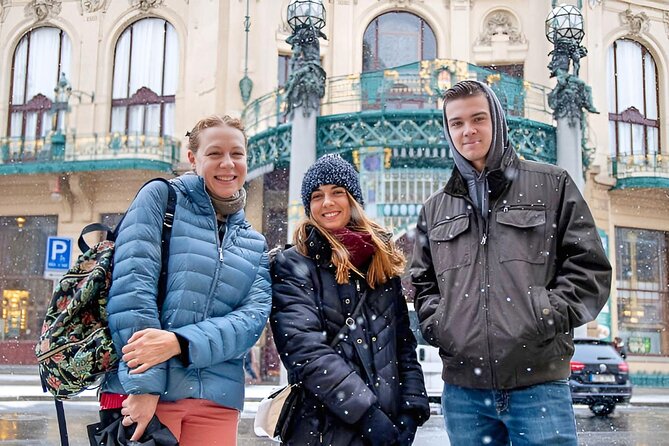
- Thirteen central Prague stops: You’ll see the Astronomical Clock, Týn Church, Charles Bridge, Jewish Quarter, Václavské náměstí, and Kafka’s kinetic statue.
- A historian leads the walk: Expect attention to Jan Hus, the Reformation, the Holy Roman Empire, Mozart, Jewish Prague, and the Czech political story.
- Private means flexible: Only your group participates, and you can shape the conversation around art, religion, politics, architecture, or local life.
- The route crosses Old and New Town: It finishes near Václavské náměstí, after views toward Prague Castle from the Vltava riverbank.
- Three hours on foot: Wear supportive shoes and expect a brisk overview rather than long visits inside each building.
- Best value for groups: The flat price covers up to 10 people, so the per-person cost drops sharply when shared by a larger family or friend group.
Prague in three hours: what this walk is really for
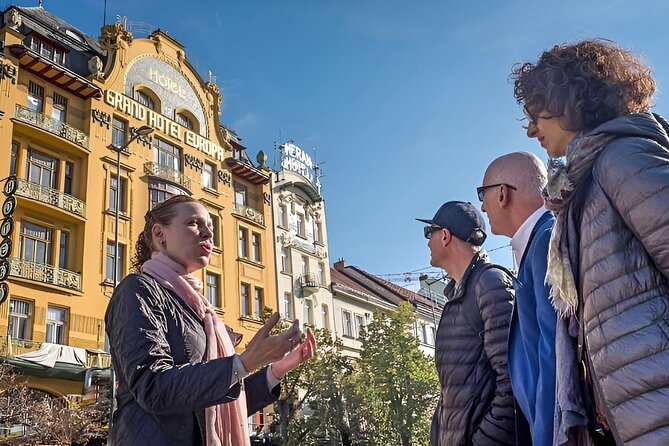
This is an orientation walk with academic muscle. You are not simply ticking off pretty façades. A good guide uses the city as a set of clues: a church shows religious change, a square reveals political power, and a street tells you what happened to a vanished neighborhood.
The tour moves through both Old Town and New Town, covering roughly a thousand years of Prague’s development in a compact morning or afternoon. The route also brings in Jewish Prague and the modern Czech Republic, so you get more than the familiar postcard version of the city.
That makes it especially useful early in a stay. You’ll learn the names and locations of major sights, then have a better sense of which churches, museums, squares, or neighborhoods deserve a longer visit later.
The private setup changes the feel of the experience. With only your own group, you can pause over a question about medieval religion, ask how Prague’s political system developed, or request more attention to Jewish history. The guide can also adjust the level for adults, children, students, or a group with a specific research interest.
More walking tours in Prague:
- Prague: 3-Hour Walking Tour of Old Town & Prague Castle
★ 4.7 · 5,696 reviews - Prague: Ghost Walking Tour Where Legends Come To Life
★ 4.4 · 5,253 reviews - Prague: Jewish Quarter Walking Tour with Admission Tickets
★ 4.7 · 3,729 reviews
Old Town Square and the Gothic skyline
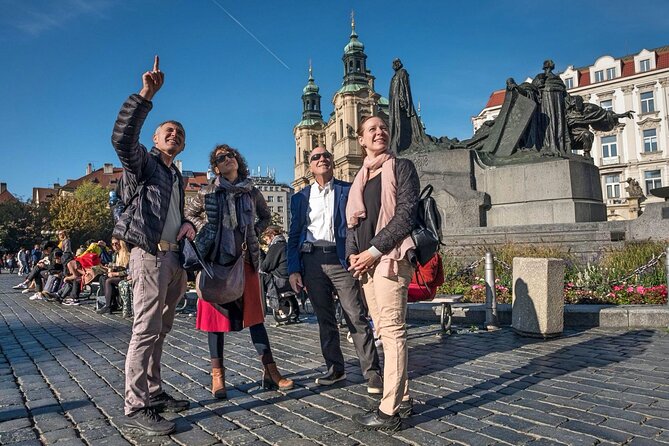
The walk begins with Prague’s central stage, Old Town Square. This was first a marketplace, and its long story includes commerce, religion, royal power, public ceremony, and political conflict.
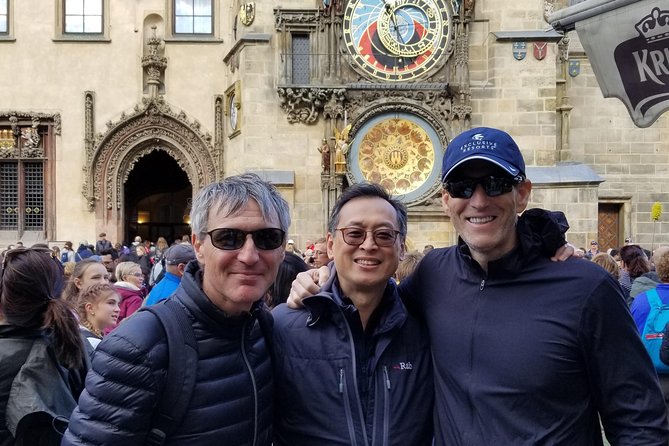
The Old Town Hall and Astronomical Clock receive about 15 minutes. Your guide explains the clock’s symbolism and the history of the hall, helping you read the building as more than a backdrop for photographs. The clock is easy to admire as a piece of medieval engineering, but the surrounding political story gives it more weight.
You then look at the Church of Our Lady before Týn, with its unmistakable late Gothic towers. Across the square, St. Nicholas Church provides a useful contrast in architectural style and religious mood. Ten minutes is enough for an exterior explanation, though you should not expect a full church visit.
The itinerary returns to Old Town Square for another 15-minute discussion. That extra time is worthwhile because the square contains several different eras at once. A guide can point out how the buildings around the market reflect Prague’s changing powers and communities.
The Jan Hus Monument adds a sharper political and religious edge. Hus was a reformer whose ideas helped shape later European Christianity and the Czech lands. His story gives you a way to understand why religious disagreement in Bohemia was not a small side issue, but a force that changed the region.
Charles Bridge, Bethlehem Chapel, and religious upheaval
From Old Town, the walk reaches Charles Bridge, one of Prague’s essential sights. The bridge is more than a scenic crossing over the Vltava. Its 600-plus-year history connects the city’s two banks and reflects Prague’s growth as an imperial capital.
The Baroque statues lining the bridge date from a later period than the Gothic structure itself. That contrast is useful: the bridge shows how Prague repeatedly added new religious and political messages to older foundations.
You receive about 15 minutes here. That is enough to discuss the bridge’s role and enjoy the setting, though crowds can make a slow, quiet inspection difficult. If the bridge is packed, your guide’s interpretation becomes even more valuable because you can focus on the structure and history instead of trying to photograph every statue.
At Bethlehem Chapel, the focus shifts to Jan Hus and the reform of the Catholic Church. This is one of the stops that separates the tour from a standard sightseeing loop. You begin to see Prague through debates about worship, authority, language, and reform.
The nearby St. Giles Church continues that theme. Your guide connects Czech religious wars, the Reformation, and the Counter-Reformation to the church’s Baroque interior and Gothic origins. Ten minutes may sound short, but the stop works well as a visual lesson: the building itself becomes evidence of changing religious fortunes.
For me, this section is one of the tour’s strongest features. Prague’s churches are easy to admire as decorative objects. Here, you also learn why their styles changed and what those changes meant to the people who used them.
New Town and Václavské náměstí
The walk then moves into Nové Město, or New Town, founded more than 600 years ago. The name can mislead you. This is not a modern district in the usual sense, but a major medieval expansion that helped Prague function as the capital of the Holy Roman Empire.
A 15-minute explanation connects New Town with the older market center. It also helps you understand Prague as a city that grew by design, not just by accident. You see how royal ambition, trade, and population needs shaped the city beyond its older core.
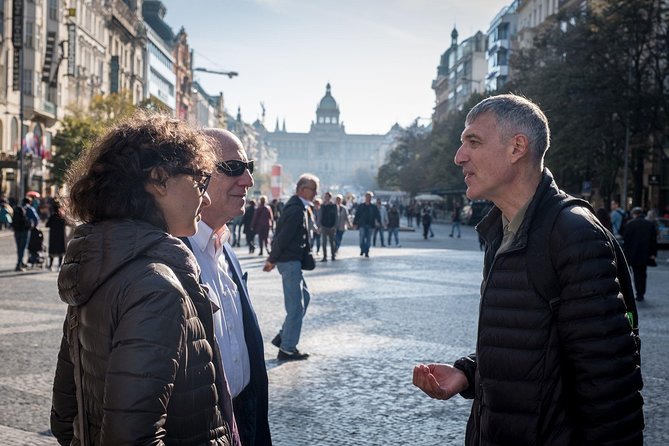
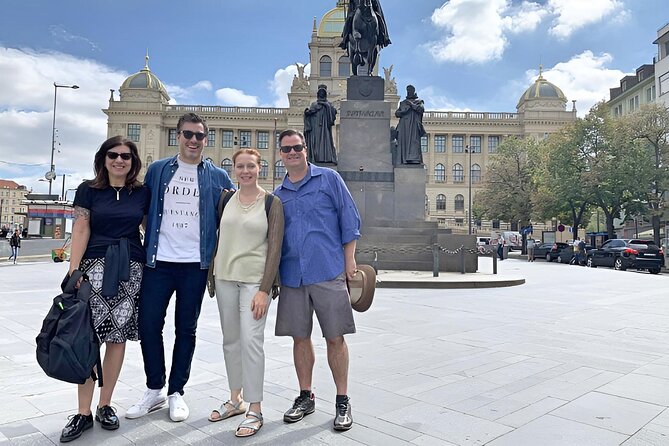
Next comes Václavské náměstí, usually translated as Wenceslas Square. Despite its name, it feels more like a long urban boulevard than a traditional enclosed square. Its importance is political as much as architectural.
Your guide places the square within the story of Prague and the Czech Republic. That context matters because many visitors see only shops, traffic, and the statue of St. Wenceslas. The square has also been a setting for public gatherings and major moments in Czech political life.
The tour ends at Václavské náměstí, which is practical if you want to continue shopping, visit a museum, find lunch, or explore New Town on your own. The supplied meeting information also gives an end point at Václavské náměstí 772/2, near Můstek.
A few more Prague half-days to weigh up
- Prague Old Town: Private Tour
★ 5.0 · 1,223 reviews - Prague Airport Private Arrival Transfer
★ 4.5 · 991 reviews - Prague Airport Private Departure Transfer
★ 4.5 · 780 reviews - Discover Prague Private Tour – 3 hours
★ 5.0 · 705 reviews
Mozart, St. Nicholas, and the city’s shifting faiths
The route includes the Theatre of the Estates, an elegant stop for the Age of Enlightenment and Mozart’s relationship with Prague. The discussion lasts about 10 minutes.
This is a welcome change of subject after the religious conflicts. Mozart helps show Prague as a major cultural center, not just a medieval city of churches and bridges. The theatre also adds a human story to the period: composers, audiences, and civic life all played a role in how the city saw itself.
The St. Nicholas Church near Old Town Square brings the discussion back to religious change and architecture. Your guide explains reversals of fortune in Czech religious life and compares Baroque and Gothic elements.
Do not confuse this with an extended interior tour. The stops are designed for interpretation from outside or for brief discussion, and admission to most named locations is not part of the package. If entering churches is a priority, ask the guide in advance how much time can be adjusted for that interest.
Jewish Prague and the Kafka finale
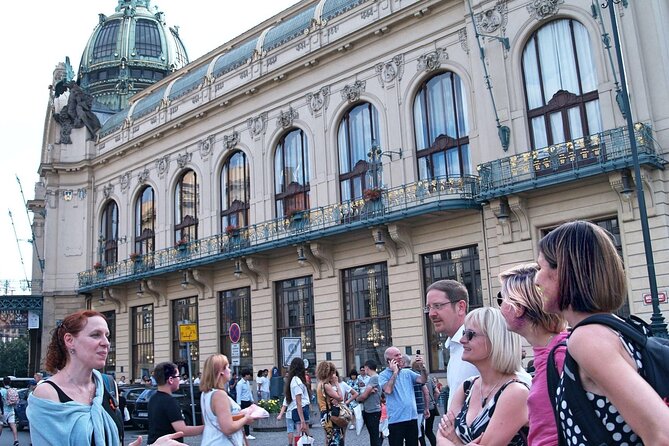
One of the most important sections comes on Pařížská Street, where the guide discusses the history and destruction of Prague’s Jewish Ghetto. This is a difficult subject, and it deserves more than a quick label on a map.
The route gives you historical context for the neighborhood and for the major changes that reshaped it. The walk does not list admission to the Jewish Museum or its synagogues, so you should plan a separate visit if you want to see those interiors and exhibitions.
The final stop is the Franz Kafka Statue, a revolving kinetic work by Czech artist David Černý. It resembles a bust of Kafka, but its moving form is far from a conventional monument. The five-minute stop offers a modern, slightly playful ending after the tour’s heavier material.
Kafka is a fitting final figure for Prague. His work is tied to the city’s German, Czech, and Jewish cultural currents, and the statue gives you a contemporary way to think about identity, memory, and urban art.
What the private guide adds
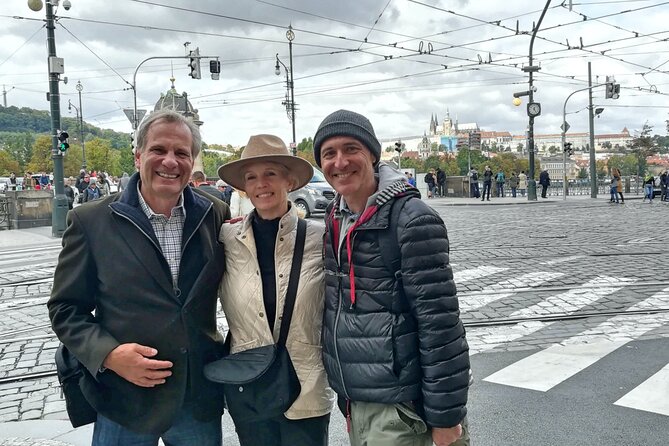
The strongest reason to choose this tour is the guide, not the number of stops. The company’s guides include Bonita and Vadim, and past praise focuses on their ability to explain rather than recite.
That distinction matters. A guide can tell you that a church is Gothic, or explain why Gothic architecture appeared when it did, how religious conflict affected it, and what later Baroque decoration was trying to communicate. The second approach gives you tools for seeing other buildings on your own.
Vadim is described as especially strong at creating a useful first overview for people new to Prague. Bonita is praised for adapting conversations to local life, families, and focused research. Pavla Zikova has also led longer, energetic tours for this company. Guide assignment is not guaranteed, so book for the private historian-led format rather than for one specific person unless the provider confirms it.
The private arrangement has a practical benefit for mixed groups. Children can ask basic questions without slowing a public group, while adults can take the discussion toward politics, architecture, or Jewish history. A large group can also stay together without trying to hear a guide over strangers.
Price, pace, and practical value
The listed price is $367.61 per group of up to 10 people. For one or two people, that is a serious expense for a three-hour walk. For six to 10 people, the math is much kinder, and the private attention can compare well with booking several separate activities.
You are paying for a historian guide and a tailored conversation, not for entrance tickets, food, drinks, or hotel transfers. Most stops are free to view, and the Kafka statue is listed as included, but the tour does not function as a ticketed church or museum program.
The schedule covers 13 stops in about three hours. That works out to a brisk rhythm, with many discussions lasting 10 to 15 minutes. You should expect walking, standing, street noise, and short explanations at several locations rather than long periods inside one monument.
The meeting information needs careful checking. The tour description says to meet at a local café in the heart of Old Town Square, while the supplied meeting point names MONDIEU, Maltezské náměstí 480 in Malá Strana. Confirm the exact start location with Insight Cities before setting out. The listed start time is 10:00 a.m., with morning and afternoon departures available if arranged at booking.
Pickup is described as offered in the summary, but the detailed inclusions say hotel pickup and drop-off are not included. Treat this as a central meeting-point walking tour unless the provider confirms another arrangement.
Wear comfortable shoes. The route is near public transportation, and most people can participate, but the experience is still a sustained city walk. If your group needs frequent rests or has mobility concerns, discuss that before booking.
Free cancellation is available up to 24 hours before the start time. Changes or cancellations inside that window are not accepted for a refund.
Who will get the most from this Prague walk?
I would choose this for a first visit, especially if you want Prague’s major sights to make historical sense rather than remain a string of photographs. It is also a good fit for parents traveling with a student, a family group with different ages, or friends who want to talk rather than follow a fixed public tour.
Students and architecture fans should find plenty to work with. The tour touches medieval markets, Gothic and Baroque design, the Holy Roman Empire, the Reformation, Jewish Prague, Mozart, Kafka, and modern Czech politics.
It is less suitable if your top goal is entering every church, visiting the Jewish Museum, or spending an hour at the Astronomical Clock. It is also not the bargain choice for a couple on a tight budget. The value depends on how much you care about private questions and a guide who can connect the stops.
Should you book the Private Prague Introduction Walking Tour?
Book it if you want a serious first look at Prague and your group values conversation. The strongest features are the private format, the guides’ historical and cultural range, and the route’s unusual balance of famous sights with subjects such as Jan Hus, Jewish Prague, Mozart, and Kafka.
Think twice if you want a slow photographic walk or a ticketed interior tour. In that case, choose a shorter route with fewer stops, or use this experience as your orientation and return later to the churches, bridge, Jewish Museum, and other sites that catch your interest.
For a group of six or more, I find the price easier to justify. For two people, book only if a private historian and a flexible discussion are worth more to you than a cheaper group walk.
FAQ
How much does the Private Prague Introduction Walking Tour cost?
The listed price is $367.61 per group, with up to 10 people included.
How long does the tour last?
The walking tour lasts approximately three hours.
What time does the tour start?
The supplied start time is 10:00 a.m. Morning and afternoon departures are available, and you should advise the provider of your preferred time when booking.
Where does the tour meet?
The detailed meeting point is MONDIEU at Maltezské náměstí 480 in Malá Strana. The description also refers to a local café in Old Town Square, so confirm the exact meeting location with Insight Cities before the tour.
Where does the tour end?
The listed end point is Václavské náměstí 772/2, near Můstek in Prague 1.
What is included?
A historian guide is included. The Franz Kafka Statue is listed with admission included.
Are food, drinks, and hotel transfers included?
No. Food and drinks are not included unless specifically stated, and hotel pickup and drop-off are not included in the detailed inclusions.
Is this a private tour?
Yes. Only your group participates, with no other booking groups joining the activity.
Can I cancel for a full refund?
Yes, if you cancel at least 24 hours before the experience start time. Cancellations or changes made less than 24 hours before the start time are not accepted for a refund.
Just added around Prague
- Prague Highlights 4 Hour Private Walking Tour★ 5.0 · 3 reviews
- VIP Prague Segway Tour Around Monastic Breweries★ 4.0 · 3 reviews
- Private Guided Tour from Prague to UNESCO Kutna Hora★ 5.0 · 3 reviews
- From Prague Day Unique Tour To Cesky Krumlov★ 4.5 · 3 reviews
- Cesky Krumlov: Insta-Perfect Walk with a Local★ 5.0 · 3 reviews
- Prague: WWII Tour with Local Historian SMALL GROUP★ 5.0 · 3 reviews
- Learn Traditional Czech Cooking from Authentic Family Recipes★ 5.0 · 3 reviews
- Prague Tour in Spanish★ 5.0 · 3 reviews
Walking Tours, compared.
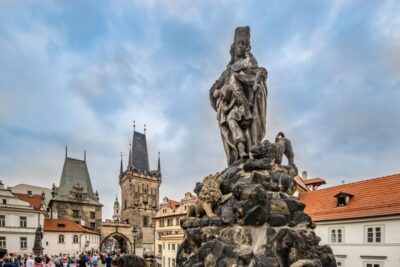
3-Hour Walking Tour of Old Town & Prague Castle
Read our review →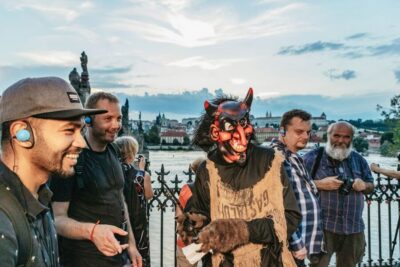
Ghost Walking Tour Where Legends Come To Life
Read our review →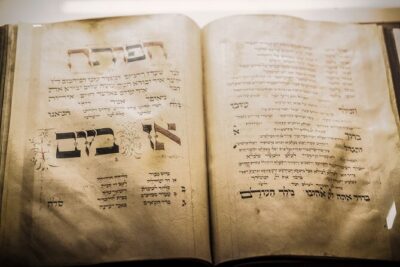
Jewish Quarter Walking Tour with Admission Tickets
Read our review →
Prague Guided Walking Tour and Cruise with Authentic Czech Lunch
Read our review →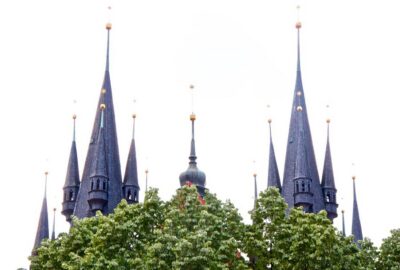
Old Town and Jewish Quarter Guided Walking Tour
Read our review →
Prague Ghost and Legend of Old Town Walking Tour
Read our review →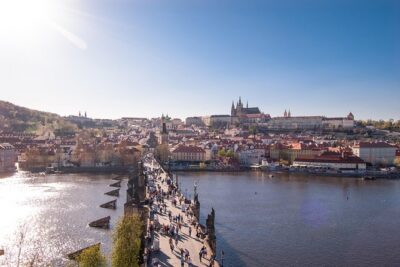
Prague 3-hour Afternoon Walking Tour including Prague Castle
Read our review →
Ghosts and Legends Nighttime Guided Walking Tour
Read our review →Browse the lists this tour appears in