
Reviewed · PRAGUE
Prague Essential
Charles Bridge is more than a pretty crossing. It is the tour’s doorway into Prague’s myths, rulers, faiths, and strange old customs. From there, private guide Darya leads you through the Old Town and Jewish Quarter, ending at the Rudolfinum after about two and a half hours.
I like the private format, since your group can keep the pace and ask questions without a crowd setting the rhythm. I also like the range: you get Charles Bridge, the Astronomical Clock, Mozart’s theatre, university history, Jewish heritage, and a Neo-Renaissance concert hall in one walk.
The main consideration is pace. There are many stops, but most are short, often five or ten minutes. This is an excellent first look at central Prague, not a slow museum tour with long interior visits.
In This Review
- Key points at a glance
- Charles Bridge gives Prague an immediate sense of mystery
- Klementinum offers a quieter pause
- Reading the Astronomical Clock instead of only watching it
- Old Town Square shows Prague at its most dramatic
- Mozart and Charles University add culture and learning
- Powder Gate marks the old entrance to the city
- The Jewish Quarter brings the most serious history
- Rudolfinum provides a polished ending
- What $96.12 buys you
- The private pace suits some visitors better than others
- A smart way to use the route
- Should you book Prague Essential?
- FAQ
- How long is Prague Essential?
- What time does the tour start?
- Where does the tour begin?
- Where does the tour finish?
- Is this a private tour?
- What language is the tour offered in?
- Is admission included at every stop?
- Can I cancel for a full refund?
Key points at a glance
- Darya leads a private English-language walk for only your group.
- Charles Bridge begins the story, with legends, facts, and a chance to make a wish.
- The route covers major central Prague sights in about two hours and thirty minutes.
- The Jewish Quarter stops carry real weight, from the Old-New Synagogue and its Golem legend to the Pinkas Synagogue memorial.
- The tour ends at Rudolfinum, a beautiful concert hall that gives the walk a graceful finish.
- At $96.12 per person, the value depends on group size and your need for a fast, guided introduction.
Charles Bridge gives Prague an immediate sense of mystery
Meet at the Charles IV statue on Křižovnické Square at 10 a.m. The location is central and near public transportation, but give yourself time to find the exact statue. The tour begins with Charles Bridge, one of Prague’s most famous sights and one of its best story machines.
The bridge is presented as an energetically charged place. Charles IV himself laid the first stone on a special date, a detail that opens the door to Prague’s fondness for astronomy, symbols, and old beliefs. You will hear the practical facts about the bridge, but also the tales that make it feel like more than a route across the river.
There is even time to discuss making a wish. That may sound light, but it suits the bridge. Prague works best when you allow room for both documented history and local legend.
This opening is useful because it gives you a setting for the rest of the walk. Instead of seeing a collection of handsome buildings, you begin to notice how power, religion, art, and superstition overlap in the city center.
Other Prague outings people book alongside this one:
- Prague: 50-Minute Sightseeing Evening Cruise
★ 4.2 · 33,780 reviews - Prague: Medieval Dinner with Unlimited Drinks
★ 4.4 · 19,847 reviews - Prague: Skip-the-line Castle Ticket and Optional AudioGuide
★ 4.3 · 11,121 reviews
Klementinum offers a quieter pause
The route then moves to the Klementinum, where the group spends about ten minutes. The tour takes you into the quiet courtyard of the former Jesuit college, away from the heaviest crowds.
That pause matters. Prague’s center can feel full of people, cameras, and competing sounds. A courtyard gives you a chance to slow down while Darya explains the Jesuit order and its role in Prague’s past. The description of the Jesuits as dangerous people hints at a more complicated story than a simple account of religious buildings and old stone.
The Klementinum section is listed with no admission fee. You should think of it as a guided look and story stop rather than a full visit to every part of the complex. If you want to tour interiors at length, you will need a separate plan.
I like this stop because it changes the mood early. You move from the open drama of Charles Bridge into a more enclosed setting, where the focus shifts from royal symbolism to education, religion, and influence.
Reading the Astronomical Clock instead of only watching it
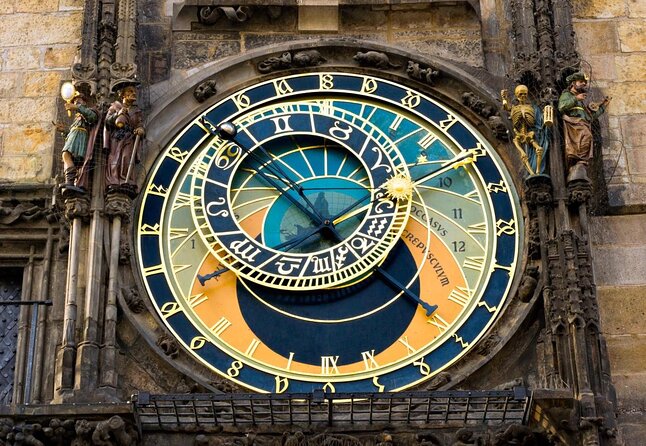
At the Old Town Hall with Astronomical Clock, the tour spends another ten minutes. Hundreds of people gather each day to watch the apostles appear from the small window, but the real value here is learning how to read the clock.
The guide explains why this clock is considered unusual despite the existence of similar medieval clocks elsewhere in Europe. You will also hear about the master who created it and the meaning behind its parts.
That makes the stop more useful than simply arriving on the hour, looking up, and moving on. If your timing lines up with the display, you can watch the short appearance of the apostles. If it does not, the explanation still gives you a way to understand the clock when you return later.
The ten-minute limit keeps the tour moving. It also means you should not expect a long technical lecture or a tower visit. The point is orientation. You learn what you are seeing, then continue into Old Town Square.
Old Town Square shows Prague at its most dramatic
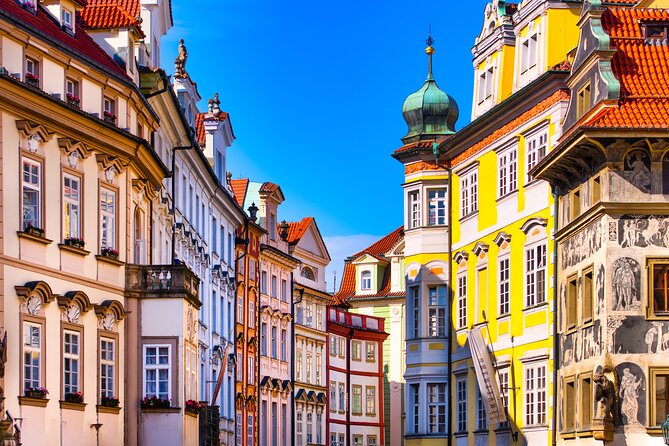
Old Town Square is described as the heart of Prague, and the tour treats it as a place where both glory and grief unfolded. It was once a major market, but it also saw terrible executions and other painful events.
This is where a good guide can change your view of a familiar postcard scene. The square’s beauty is obvious. The harder stories are easier to miss. Darya connects the buildings and open space to the events that shaped Prague, including heartbreaking episodes that remain part of the city’s memory.
You have about ten minutes here. That is enough for a focused explanation and a look around, but not enough to examine every facade or enter several buildings. I suggest using this stop to note what you want to revisit on your own.
The square also helps you get your bearings. After Charles Bridge and Klementinum, you understand how the route is threading through Prague’s historic core rather than simply checking off isolated sights.
Same city, a completely different afternoon:
- Prague: Castle Tour with Local Guide and Entry Ticket
★ 4.6 · 10,422 reviews - Prague Castle 2.5-Hour Tour Including Admission Ticket
★ 4.7 · 8,927 reviews - Prague: Oldtown, Medieval Underground & Dungeon History Tour
★ 4.2 · 8,244 reviews - Prague: Vltava River Night Cruise with Buffet
★ 4.3 · 7,338 reviews
Mozart and Charles University add culture and learning
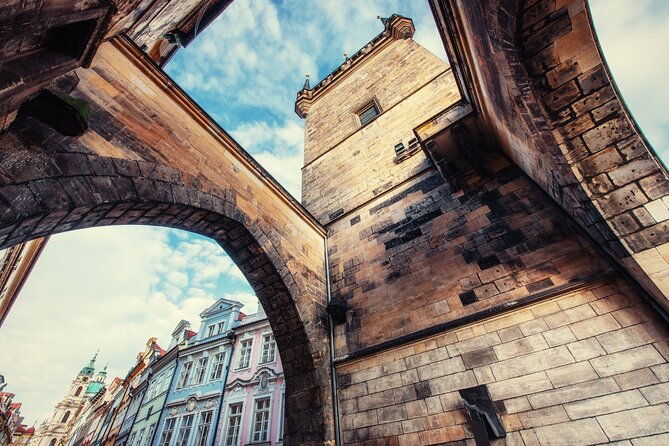
The Theatre of the Estates is next, with a short stop of about ten minutes. This magnificent building is tied to Mozart, who performed there. For music lovers, that connection gives the route a strong cultural note. Even if you know little about opera, the theatre helps show how Prague’s story includes performance and public life, not only churches and royal monuments.
Admission is not included at this stop. The scheduled visit is brief, so you should not expect a full performance, backstage visit, or extended interior tour. The value comes from seeing the building and hearing why it matters.
Karolinum follows for about five minutes. It is the main campus of Charles University, with a long and fascinating story. Five minutes is a quick introduction, but it places Prague’s academic life into the larger picture.
These two stops work well together. One represents music and the stage, the other higher education. Both show how the city became a center of culture and learning. If either subject interests you deeply, mark the location for a longer return visit.
Powder Gate marks the old entrance to the city
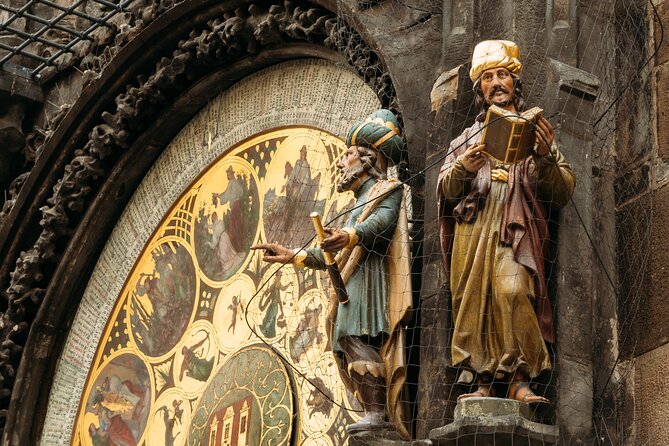
Prasna brana, or the Powder Gate, receives about five minutes. This impressive Gothic tower once served as a gateway into the Old Town.
The stop is short, but the tower has clear visual power. It reminds you that Prague was once entered through defined gates, not crossed by modern streets and open traffic routes. The Gothic design also gives the route a change of texture after the theatrical facade of the Estates Theatre and the university buildings.
Admission is not included. The tour does not promise a climb or interior visit, so treat this as an exterior landmark and a piece of the city’s old defensive and ceremonial setting.
Five minutes may feel brief here, especially if you enjoy architecture. Still, the tower is easy to recognize, and Darya’s explanation gives it context instead of leaving it as another attractive structure in the background.
The Jewish Quarter brings the most serious history
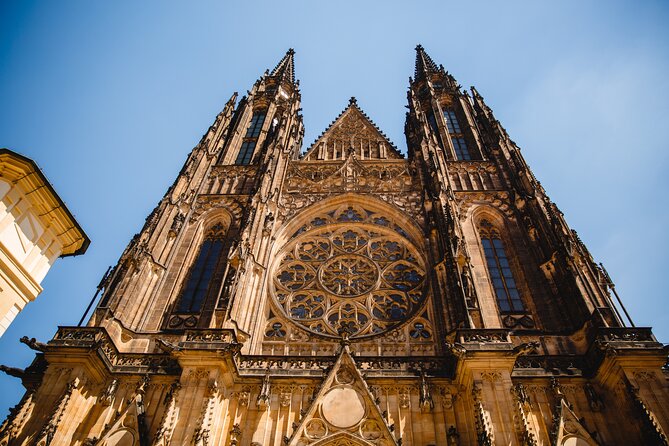
The Old-New Synagogue is one of the most important stops on the walk. It is described as the oldest synagogue in Europe and is linked to the legend of the Golem. That combination of surviving Jewish heritage and folklore makes the building especially memorable.
The Golem story adds a layer of Prague legend, but the synagogue itself is not merely a backdrop for a tale. The tour places it within the Jewish Quarter and gives you a chance to consider the community, traditions, and stories connected with the building.
The stop lasts about ten minutes, and admission is not included. You should confirm your own plans if you want to go inside or spend more time there. The walk gives you context, but it is not designed as a complete synagogue visit.
The Pinkas Synagogue follows for another ten minutes. Its purpose is different and much heavier. It is a place of memory dedicated to Jewish victims of World War II.
This part of the route asks for attention and respect. The contrast with the Golem legend is important: Prague’s Jewish Quarter holds both old stories and painful modern memory. Darya’s route does not treat the area as a collection of picturesque buildings. It points to the people and events behind the walls.
Admission is not included here as well. The ten-minute stop can introduce the memorial, but you may want more time afterward if you wish to visit the interior or reflect quietly. I would avoid scheduling this portion too tightly with another activity.
Rudolfinum provides a polished ending
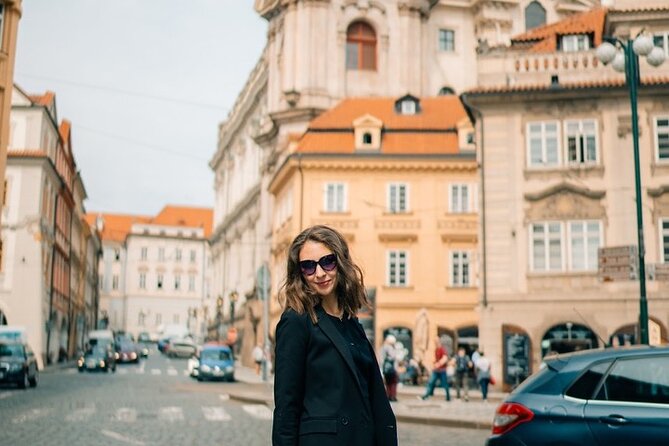
The walk finishes at Rudolfinum, at Alšovo nábřeží 79/12. This Neo-Renaissance concert hall is an incredibly beautiful final sight, and it gives the tour a clean endpoint rather than sending you back to the starting square.
The ending works on several levels. Architecturally, the building is a strong visual finish. Culturally, it returns the story to music after the earlier Mozart stop. Practically, it leaves you in central Prague, where you can continue exploring or use nearby public transportation.
The route covers a lot before arriving here. If you have tickets for an event at Rudolfinum, check the timing carefully, since the walk lasts about two hours and thirty minutes and starts at 10 a.m. The tour finishes in front of the concert hall, not inside it.
What $96.12 buys you
The price is $96.12 per person. That is not a bargain-priced group stroll, but the comparison changes because this is a private experience. Your group alone participates, and Darya can shape the conversation around your questions and interests.
For two people, the per-person cost is a serious consideration. For a family or small group, the private format may make more sense, especially if you value a flexible pace and direct conversation. The tour also covers a wide section of central Prague without requiring you to arrange separate introductions to each area.
Admission costs are not included at several stops, including the Theatre of the Estates, Karolinum, Powder Gate, Old-New Synagogue, Pinkas Synagogue, and Rudolfinum. The route appears focused on exterior views and guided explanations, so budget separately if you plan to enter these sites later.
The best value comes from using the walk as your first Prague orientation. You see the key sights, learn which places deserve a longer return, and gain enough context to explore with more purpose. If you already know Prague well, the short stops may feel too familiar.
The private pace suits some visitors better than others
This experience is a good match for a first visit, especially if you want the major sights explained in plain language rather than viewed in silence. It also suits a small family or friend group that wants to ask questions without joining a large party.
Darya’s style, based on the experience details provided, combines facts with stories. The strongest praise centers on her ability to explain many parts of Prague clearly and keep the walk engaging. One detailed assessment describes seeing the main highlights in two hours and calls the format a perfect introduction, which is a fair description of the tour’s purpose.
The schedule is less suited to anyone who wants long interior visits, extensive photography time, or a slow architectural study. Ten minutes at a major square or synagogue is enough for an introduction, but not enough for a full examination.
Most people can participate, and the tour is near public transportation. It is offered in English and uses a mobile ticket. The start time is fixed at 10 a.m., so arrive ready to walk and keep your meeting point details handy.
A smart way to use the route
I would treat the experience as a map for the rest of your Prague stay. During the walk, note the sites that deserve a return visit, particularly the Astronomical Clock, the Old-New Synagogue, Pinkas Synagogue, and any building whose interior interests you.
Keep the tour’s emotional changes in mind. Charles Bridge and the Golem legend bring mystery and imagination. Old Town Square and Pinkas Synagogue require a more serious mood. The Theatre of the Estates and Rudolfinum bring music and architecture back into the picture.
Because the route is packed with stops, wear sensible walking shoes and avoid placing a tight appointment immediately afterward. The supplied duration is approximate, and questions or a slower group could affect the finish time. That is not a flaw in a private walk, but it is worth planning around.
Free cancellation is available if you cancel at least 24 hours before the start time. Changes or cancellations inside that window are not accepted for a refund, and the cut-off follows Prague local time.
Should you book Prague Essential?
Book this tour if you want a private, English-language introduction that ties Prague’s major sights to memorable stories. Darya’s route is especially useful for a first morning in the city, since it gives you the basic shape of Old Town, the Jewish Quarter, and the riverfront in one outing.
Think twice if you want detailed access to interiors or a slow museum-style experience. The short stops and extra admission costs mean you are paying mainly for Darya’s explanations, the private setting, and the efficient route.
At $96.12 per person, the strongest case is a small group that values personal attention and wants to get oriented quickly. If that sounds like your kind of first day in Prague, this walk makes a solid starting point.
FAQ
How long is Prague Essential?
The tour lasts approximately 2 hours and 30 minutes.
What time does the tour start?
The scheduled start time is 10:00 a.m.
Where does the tour begin?
It begins at the Charles IV Statue on Křižovnické Square in Prague’s Old Town.
Where does the tour finish?
The tour finishes in front of Rudolfinum at Alšovo nábřeží 79/12.
Is this a private tour?
Yes. Only your group participates in the activity.
What language is the tour offered in?
The tour is offered in English.
Is admission included at every stop?
No. Admission is listed as free at Klementinum and the Old Town Hall with Astronomical Clock. Admission is not included at the Theatre of the Estates, Karolinum, Powder Gate, Old-New Synagogue, Pinkas Synagogue, or Rudolfinum.
Can I cancel for a full refund?
Yes, if you cancel at least 24 hours before the experience start time. Cancellations or changes made less than 24 hours before the start time are not accepted for a refund.
Just added around Prague
- Prague Highlights 4 Hour Private Walking Tour★ 5.0 · 3 reviews
- VIP Prague Segway Tour Around Monastic Breweries★ 4.0 · 3 reviews
- From Prague Day Unique Tour To Cesky Krumlov★ 4.5 · 3 reviews
- Private Guided Tour from Prague to UNESCO Kutna Hora★ 5.0 · 3 reviews
- Cesky Krumlov: Insta-Perfect Walk with a Local★ 5.0 · 3 reviews
- Prague: WWII Tour with Local Historian SMALL GROUP★ 5.0 · 3 reviews
- Learn Traditional Czech Cooking from Authentic Family Recipes★ 5.0 · 3 reviews
- Prague Tour in Spanish★ 5.0 · 3 reviews