Reviewed · PRIVATE
Prague: Private Prague Art Nouveau and Cubism Tour
Prague’s Art Nouveau and Cubist buildings tell a more surprising story than the city’s famous medieval churches. This private walk links Central Station, Municipal House, the House of the Black Madonna, Wenceslas Square, and the bold Cubist houses below Vyšehrad. I especially like the clear style-by-style explanation and the chance to see areas most visitors skip.
I also like that the route uses public transportation to reach the outlying Cubist buildings, with tickets included. Guides such as Max and Eva have earned praise for explaining both art and politics in a friendly way. The main drawback is length: at about three and a half hours, the final section may feel long if you prefer a shorter city walk.
In This Review
- Key points before you book
- Why Prague’s modern buildings deserve your time
- Starting on Platform 1 at Central Station
- From the Jubilee Synagogue to Municipal House
- The House of the Black Madonna and Czech Cubism
- Wenceslas Square puts the styles into city life
- A short tram ride to Prague’s boldest Cubist houses
- Three Cubist Houses and Kovařovicova villa
- What the guides add to the experience
- How demanding is the route?
- Is $84 per person good value?
- Who should book this Prague architecture tour?
- Should you book it?
- FAQ
- Where does the tour meet?
- How long does the tour last?
- Which languages are available?
- Is this a private tour?
- What buildings are visited?
- Are public transportation tickets included?
- Is the tour wheelchair accessible?
- Are children allowed to join?
- What should I bring?
Key points before you book
- Start at Central Station: Meet in the middle of Platform 1 beside the UniCredit Bank ATM, with your guide carrying a red folder.
- Follow Art Nouveau’s rise: See how Prague’s Belle Epoque buildings grew out of older 19th-century styles.
- Study Czech Cubism: Visit the House of the Black Madonna and several daring Cubist buildings near Vyšehrad.
- Use trams like a local: Public transportation takes you from central Prague to the final architectural stops, and tickets are included.
- Expect a private walk: The guide can respond to your questions and shape the discussion around your interests.
- Allow about three and a half hours: Comfortable shoes matter, and the route may feel too long for younger children.
Why Prague’s modern buildings deserve your time
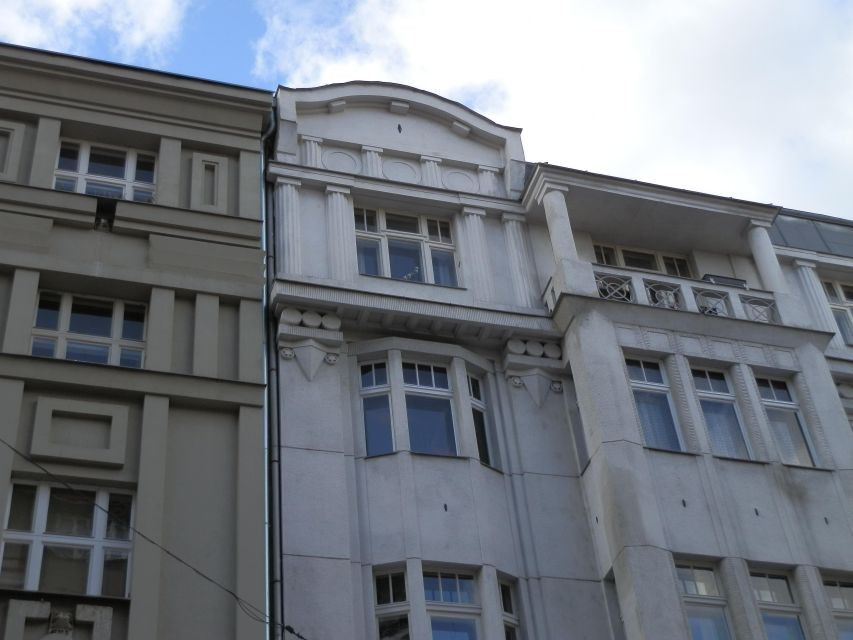
Most first visits to Prague focus on Gothic towers, Baroque churches, and the Charles Bridge. That makes sense, but it can leave the city’s early modern architecture in the shadows. This tour gives you another way to read Prague, through buildings created when the city was changing fast.
At the turn of the 20th century, architects were looking for a new visual language. Art Nouveau brought flowing lines, plant forms, decorative metalwork, colored glass, and carefully designed interiors. It reacted against plain industrial building while still making use of new materials and construction methods.
The tour also explains why Art Nouveau mattered beyond decoration. It helped create the idea that every part of a building, from its facade to its furniture, could belong to one artistic whole. In Prague, that approach often blended with local traditions and older city forms.
Cubism then pushed in another direction. Instead of soft curves and floral ornament, Czech Cubist architects favored sharp angles, faceted surfaces, and geometric shapes. The style was not simply a copy of Cubism in painting. Prague developed its own architectural version, making this city one of the best places to see Cubism applied to actual buildings.
Your guide connects these styles to the upheaval of the early 20th century. World War I changed the economy, politics, and taste of Europe, and neither Art Nouveau nor Cubism continued in quite the same way. The buildings therefore become more than pretty stops. They show how Prague’s culture responded to a period of rapid change.
A few more Prague half-days to weigh up
- Prague Old Town: Private Tour
★ 5.0 · 1,223 reviews - Prague Airport Private Arrival Transfer
★ 4.5 · 991 reviews - Prague Airport Private Departure Transfer
★ 4.5 · 780 reviews
Starting on Platform 1 at Central Station
The meeting point is in the middle of Platform 1 at Prague’s Central Train Station, near the UniCredit Bank ATM. Look for the guide with a red folder. This is a practical starting place, especially if you arrive by train or are staying near the main station.
The station itself is an important first stop. The building dates from 1909 and has recently been reconstructed. Its architecture introduces the Belle Epoque before the walk moves into New Town. You get an early example of how public buildings used decoration and modern engineering to express confidence in the future.
The guide spends about 15 minutes here. That is enough time to set up the main ideas without turning the station into a long lecture. Pay attention to the contrast between a major transport building and the more intimate commercial and residential structures later in the route.
From the station, you walk for about five minutes to the Jubilee Synagogue. Another five-minute walk follows, then several short stops at lesser-known buildings. This early portion is useful because it lets you compare different forms of ornament rather than seeing Art Nouveau as one fixed look.
From the Jubilee Synagogue to Municipal House
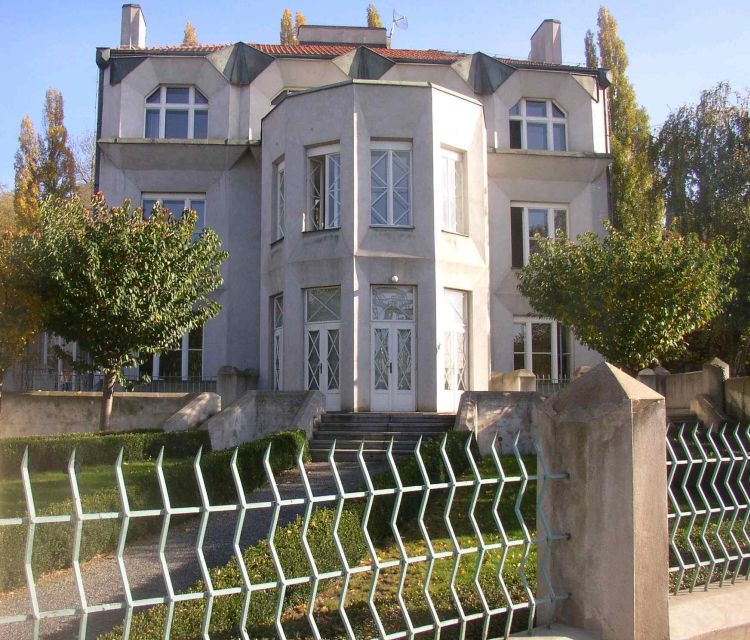
The Jubilee Synagogue receives a short sightseeing stop of about five minutes. It helps broaden the architectural story, since Prague’s turn-of-the-century design cannot be separated from the city’s religious and cultural life.
The route then moves through a series of lesser-known buildings. Each stop lasts about five minutes, with short walks of three to five minutes between them. These pauses are brief, so the value comes from the guide’s explanation of details you might otherwise pass without noticing.
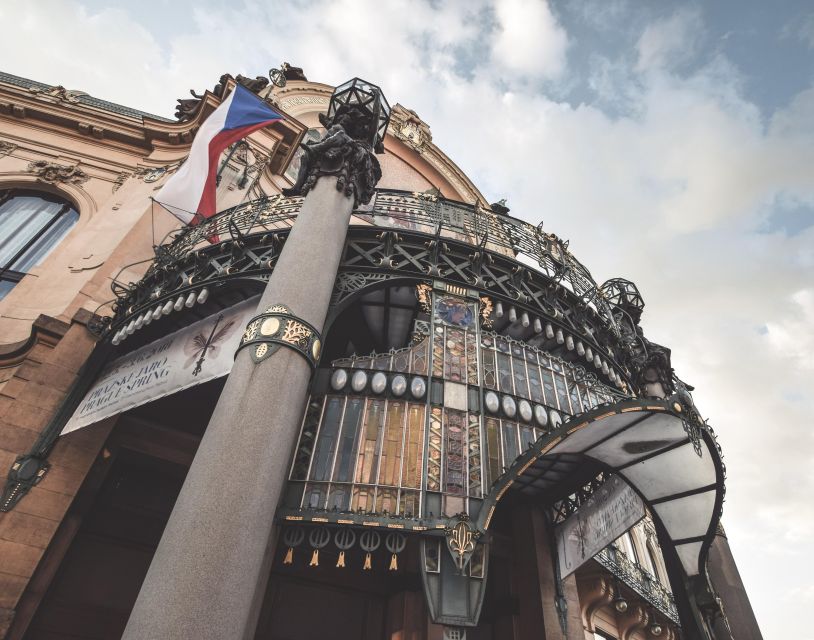
After another short walk, you reach Municipal House, where the tour spends around 10 minutes. This is one of Prague’s major Art Nouveau landmarks, but the focus here is not simply on taking a photograph. You learn how the style developed from 19th-century architecture and why its decorative approach felt new at the time.
Municipal House is a good place to grasp the confidence of the period. Its design reflects a city eager to present itself as modern, cultured, and capable of producing work on an international level. The building also shows how Art Nouveau could operate on a grand civic scale rather than only on apartment facades or shop interiors.
The House of the Black Madonna and Czech Cubism
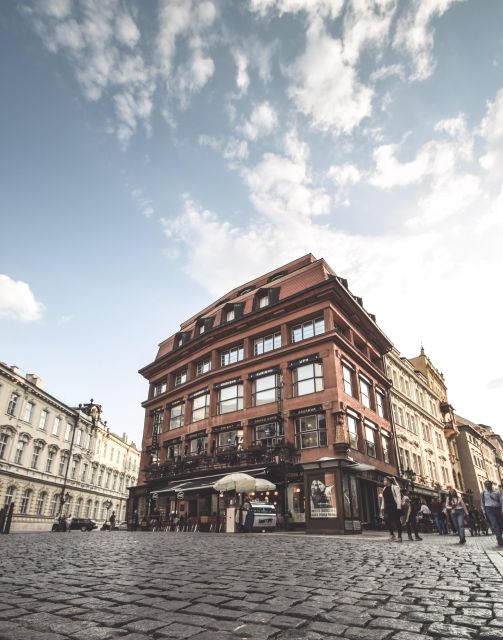
A three-minute walk brings you to the House of the Black Madonna. The stop lasts about 10 minutes, making it one of the more substantial points in the central part of the route.
This building is central to the story of Czech Cubism. Its angular design shows how architects translated the sharp, broken forms associated with Cubist art into architecture. Look for the way the facade treats surfaces and shapes as if they have been folded or cut into planes.
The building is also valuable because it demonstrates that Cubism in Prague was not merely a passing decorative trick. It affected the structure’s visual character and the way people experienced the spaces around it. Your guide explains why Cubism emerged partly as a reaction against Art Nouveau’s popularity.
After the House of the Black Madonna, the route continues to more short stops. You will see other buildings where the transition between styles becomes easier to understand. The point is not to memorize architectural labels. It is to train your eye to notice curves, angles, ornament, symmetry, and the relationship between a building and the street.
Same city, a completely different afternoon:
- Prague: 50-Minute Sightseeing Evening Cruise
★ 4.2 · 33,780 reviews - Prague: Medieval Dinner with Unlimited Drinks
★ 4.4 · 19,847 reviews - Prague: Skip-the-line Castle Ticket and Optional AudioGuide
★ 4.3 · 11,121 reviews - Prague: Castle Tour with Local Guide and Entry Ticket
★ 4.6 · 10,422 reviews
Wenceslas Square puts the styles into city life
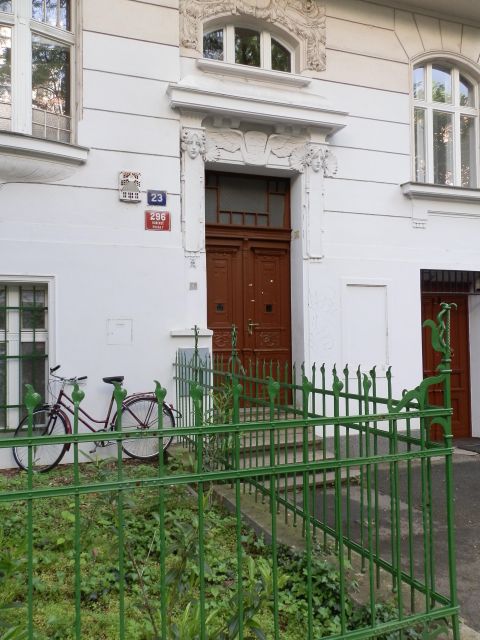
The walk reaches Wenceslas Square for about 20 minutes, the longest sightseeing stop in the central area. This gives you time to consider the architecture within the broader life of Prague.
Wenceslas Square is not an isolated architectural display. It is a major urban space, shaped by commerce, public events, political change, and everyday movement. That makes it a useful setting for understanding why modern architecture mattered. These buildings were designed for a living city, not a museum district.
The guide uses the square to connect architecture with the 20th century. Art Nouveau and Cubism were part of a period when Prague was defining its cultural identity and looking for ways to express modernity while remaining tied to its past.
This is also where the tour’s local point of view becomes especially useful. Instead of treating Prague as a collection of postcard scenes, the route asks you to notice how its residents moved through the city and how newer buildings were fitted around older architecture.
A short tram ride to Prague’s boldest Cubist houses
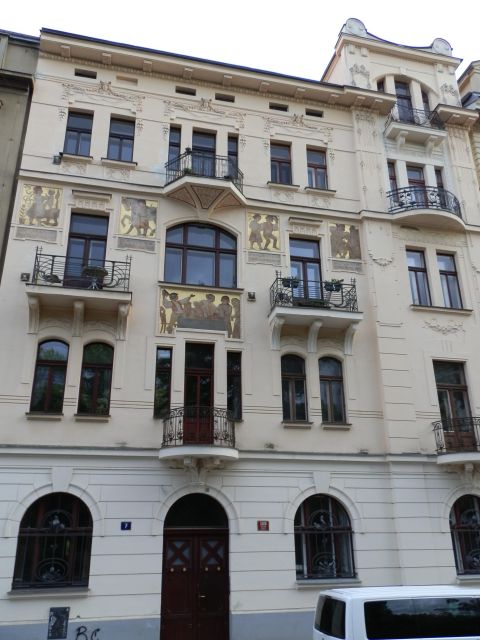
After another brief stop, you board a tram for about five minutes. You then make a second short tram journey before walking roughly five minutes to the final group of buildings. Public transportation tickets for the rides there and back are included.
The change of pace is important. You leave the busiest central streets and reach a quieter area beneath the Vyšehrad fortress. The final section is where the tour becomes most specialized. If you have already seen Prague Castle, the Old Town Square, and the Charles Bridge, this is a strong reason to choose this experience.
The remote setting also changes how the architecture feels. In central Prague, Art Nouveau and Cubist buildings compete with many famous landmarks. Near Vyšehrad, the buildings have more room to make their own impression.
Three Cubist Houses and Kovařovicova villa
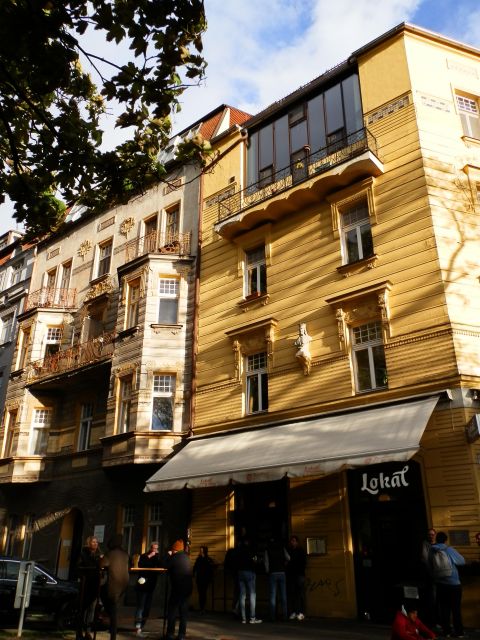
The Three Cubist Houses receive a five-minute stop. These buildings offer a direct look at the geometric side of Prague Cubism, with forms that feel sharper and more forceful than the flowing lines of Art Nouveau.
The guide’s job here is to point out the features that are easy to miss at street level. Cubist architecture can seem plain if you only glance at it. Once you notice its angled surfaces and deliberate geometry, the design becomes much more expressive.
A five-minute walk leads to Kovařovicova vila, followed by another short walk to Cubist house Vyšehrad č. p. 98. These stops make the final section worthwhile for anyone with a serious interest in architecture. They show that Prague Cubism was not limited to one famous building in the center.
Kovařovicova vila and the house at Vyšehrad number 98 also help you see how the style worked in residential settings. This is different from the civic scale of Municipal House or the commercial importance of the House of the Black Madonna. You get a broader picture of Cubism as an approach to private buildings and neighborhood streets.
A tram stop is conveniently located near the end of the route, so you can return downtown by public transportation. The tour does not leave you stranded in an unfamiliar part of the city.
What the guides add to the experience
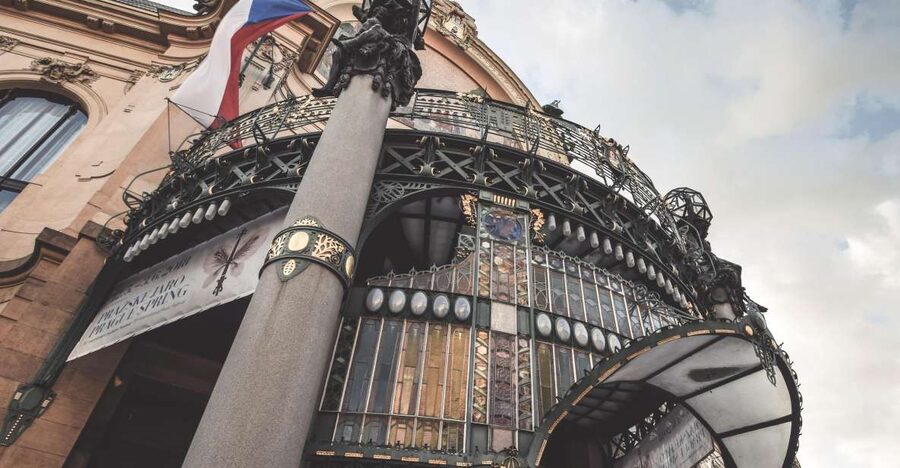
This is a private tour, so the guide can answer questions instead of delivering a fixed speech to a large group. That matters on a subject with plenty of visual detail. You can ask why one facade looks floral, why another appears angular, or how the styles relate to Prague’s older buildings.
Max has guided in both English and German. He is praised for presenting the development of Art Nouveau and its local forms in a clear, engaging way, and for answering questions with confidence. Eva also guides the tour and is praised for explaining the many architectural styles in a clear, educational fashion.
If you speak German, the tour may be a particularly good fit. Max has been described as presenting the subject in fluent German and showing buildings well outside the main sightseeing circuit.
The strongest feature is not simply the number of buildings. It is the guide’s ability to turn them into evidence. Instead of saying that a structure is Art Nouveau or Cubist, a good explanation shows you why. That makes the information easier to remember when you continue exploring Prague on your own.
How demanding is the route?
The walk includes many short stretches rather than one long march. Most listed walks take three to five minutes, and the public transportation sections are short. Still, the total experience is substantial, with central Prague sightseeing followed by the outlying Vyšehrad area.
Bring comfortable shoes. You will spend much of the tour on city streets, moving between stops and looking upward at facades. The activity is wheelchair accessible, though the exact ease of each street section may depend on conditions at the time of the tour.
Children under 12 are not permitted. Older children and teenagers who already enjoy buildings, design, or history may appreciate the route, but the subject is fairly specialized. It is better suited to adults and older students than to families seeking a general city introduction.
One practical point: a score of three and a half hours is useful for planning lunch or another reservation afterward. The route is described as a one-day activity in the booking information, but the actual walking program is a half-day experience rather than an all-day outing.
Is $84 per person good value?
At $84 per person, this is not the cheapest way to see Prague’s architecture. You are paying for a private experience, an expert-led theme, and included tram tickets rather than simply following a free self-guided route.
The value is strongest for two types of visitors. First, if you have already covered Prague’s main sights, the tour takes you into a less familiar side of the city. Second, if you care about architecture and want context instead of isolated photographs, the guide’s explanations justify the price.
A private group also gives you more room to ask questions and move at a sensible pace. The downside is that you do not get the cost advantage of a large shared tour. If your only goal is to see Municipal House or the House of the Black Madonna, you can visit central landmarks independently for less.
The included transport helps a little, but it is not the main reason to book. The real value lies in connecting buildings across the city and explaining how Art Nouveau and Cubism fit into Prague’s modern cultural story.
Who should book this Prague architecture tour?
I would choose this for a repeat visitor, an architecture student, or anyone spending a week in Prague who wants something beyond the standard route. It is also a good pick if you enjoy asking detailed questions and prefer a private guide to a large group.
The tour works best when you are willing to look closely. Some stops last only five minutes, and the buildings may not announce themselves with a famous name or a grand square. The reward comes from learning what to notice.
You may want to skip it if you want a short introduction to Prague, dislike extended walking, or have a tight schedule. One person found the final part too long and felt that two and a half to three hours would have been enough. That is a fair warning, especially if you are not strongly interested in Cubism.
Should you book it?
Book this private Art Nouveau and Cubism tour if you want Prague explained through its early modern buildings, not just its medieval skyline. The central stops are easy to fit into a sightseeing day, while the tram ride to Vyšehrad gives the tour a more local feel.
I would especially recommend it after you have visited Prague’s headline sights. The final Cubist houses are the key reason to choose this experience over a general architecture walk. If you prefer a shorter outing, ask yourself if the remote section is likely to interest you, since that is the part most likely to test your patience.
FAQ
Where does the tour meet?
Meet in the middle of Platform 1 at Prague’s Central Train Station, beside the UniCredit Bank ATM. The guide carries a red folder.
How long does the tour last?
The activity is listed as valid for one day, while the walking program takes roughly three and a half hours. Allow half a day for the complete route.
Which languages are available?
The tour is offered in English and German.
Is this a private tour?
Yes. It is arranged for a private group.
What buildings are visited?
The route includes Prague Main Railway Station, the Jubilee Synagogue, Municipal House, the House of the Black Madonna, Wenceslas Square, the Three Cubist Houses, Kovařovicova vila, and Cubist house Vyšehrad number 98, along with additional lesser-known buildings.
Are public transportation tickets included?
Yes. Tickets for the public transportation used during the tour are included, including the tram rides to and from the Vyšehrad area.
Is the tour wheelchair accessible?
Yes, the activity is listed as wheelchair accessible.
Are children allowed to join?
Children under 12 are not suitable for this tour.
What should I bring?
Wear comfortable shoes, since the experience includes several walking sections between architectural stops.
Just added around Prague
- Prague Highlights 4 Hour Private Walking Tour★ 5.0 · 3 reviews
- VIP Prague Segway Tour Around Monastic Breweries★ 4.0 · 3 reviews
- Private Guided Tour from Prague to UNESCO Kutna Hora★ 5.0 · 3 reviews
- From Prague Day Unique Tour To Cesky Krumlov★ 4.5 · 3 reviews
- Prague: WWII Tour with Local Historian SMALL GROUP★ 5.0 · 3 reviews
- Cesky Krumlov: Insta-Perfect Walk with a Local★ 5.0 · 3 reviews
- Learn Traditional Czech Cooking from Authentic Family Recipes★ 5.0 · 3 reviews
- Prague Tour in Spanish★ 5.0 · 3 reviews
Private, compared.

Shared Group/Private Segway Tour with Hotel Transfer
Read our review →
Winter Charm of Prague – private tour with PERSONAL PRAGUE GUIDE
Read our review →
Bohemian & Saxon Switzerland Semi Private Tour
Read our review →
Best of Prague Private Walking Tour (Left and Right Riverbank)
Read our review →