
Reviewed · PRAGUE
The Plague Doctor of Prague
Prague’s Plague Doctor tour turns a grim subject into an engaging walk through the city’s oldest streets. In about 90 minutes, you follow a costumed guide from the House of the Golden Well to St. Agnes Convent, learning how people explained disease, endured quarantine, and tried to treat the sick in 1715.
I like the way the tour joins public health with daily life, rather than treating the plague as a string of spooky stories. I also like the small group limit, the group photo with the plague doctor, and the fact that the walk brings in Prague’s Jewish communities, merchants, hospitals, churches, and monasteries.
The main drawback is that the tour is more about plague life and medical beliefs than Prague architecture. If you want a full account of the city’s buildings, you may find the historical setting a little thin. One practical note: a past participant found the costume needed freshening, so the theatrical detail is not always perfect.
In This Review
- Key points to know before you book
- A plague doctor meets you at the House of the Golden Well
- Klementinum and the hard facts of quarantine
- Old Town Square, merchants, and wartime Prague
- Franz Kafka, Jewish Prague, and Albert Camus
- The old hospital at St. Simon and Jude
- St. Agnes Convent provides a quiet ending
- What the guides do best
- Walking effort, group size, and timing
- Is $26.61 a fair price?
- Who should book the Plague Doctor of Prague?
- FAQ
- Where does the Plague Doctor of Prague tour start?
- Where does the tour end?
- How long does the experience last?
- What language is the tour offered in?
- How much does the tour cost?
- How many people can join the tour?
- Is the tour suitable for most people?
- Can I cancel for a full refund?
- Should you book it?
Key points to know before you book
- The 90-minute route links six Prague locations, ending at St. Agnes Convent rather than returning to the starting point.
- Guides keep the tone lively, with Thomas, David, Oskar, Oscar, and Maddie all praised for humor, clear explanations, and strong performances.
- The subject goes beyond the Black Death, covering quarantine, old medical treatments, plague causes, Jewish life, and the 30 Years’ War.
- The group is capped at 10 people, which helps you hear the guide in narrow streets and ask questions.
- Families can take part, with several accounts describing the experience as suitable for children, teenagers, and adults.
- At $26.61 per person, the tour offers a reasonably priced evening activity, especially if you want history mixed with theatrical fun.
A plague doctor meets you at the House of the Golden Well
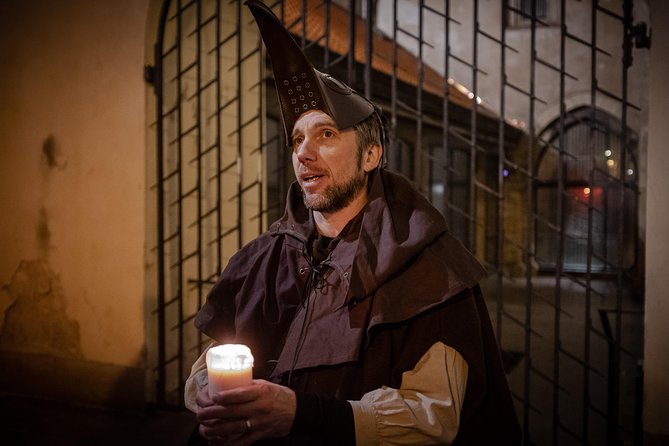
The walk begins at Aurus Hotel Prague, at Karlova 3 in the Old Town. Your guide introduces Alexander Schamsky, the plague doctor figure who leads the tour back to 1715.
This first stop lasts about 10 minutes. It sets the mood without wasting time. You learn about the building called the House of the Golden Well, then meet the plague saints Sebastian and Rochus. These saints mattered because people facing disease looked to religion, ritual, and divine protection when medical answers were limited.
You also hear about the causes people once blamed for plague. The explanations could include bad air, divine punishment, personal behavior, or other beliefs that now seem strange but made sense within the knowledge of the time. This is a useful opening because it shows that a plague doctor was working in a world without modern germ theory.
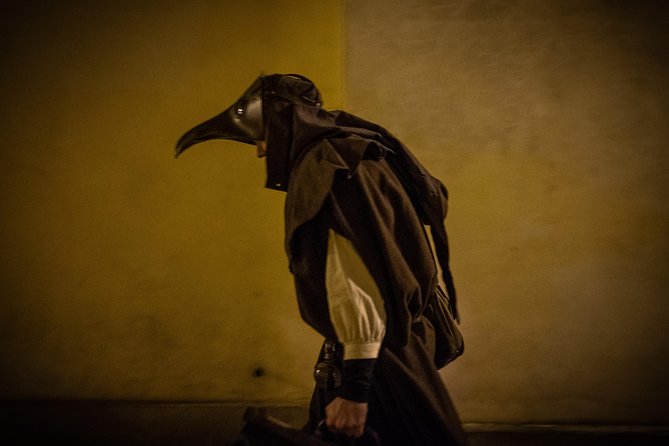
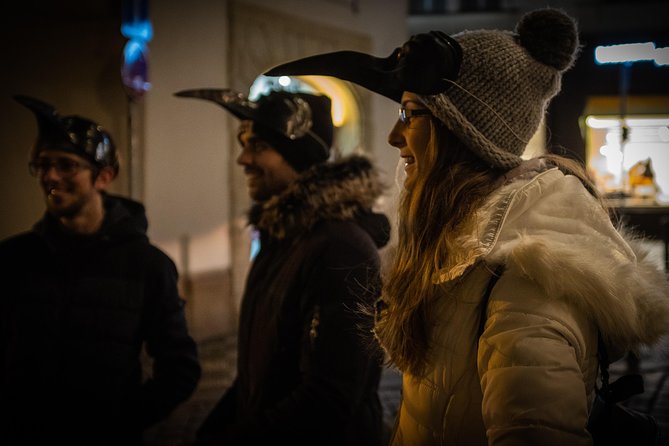
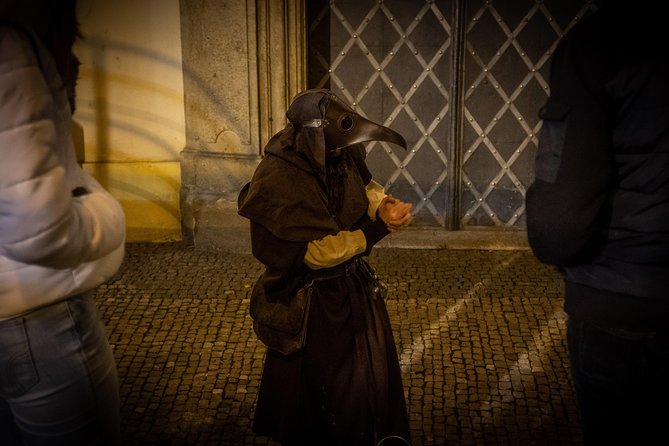
The costumed character adds atmosphere, but the quality of the experience depends on the person wearing the costume. Guides named Thomas, David, Oskar, Oscar, and Maddie have been associated with the tour, and the strongest descriptions emphasize their ability to stay in character while explaining difficult facts. Expect a performance, not a dry lecture.
Other Prague outings people book alongside this one:
- Prague: 50-Minute Sightseeing Evening Cruise
★ 4.2 · 33,780 reviews - Prague: Medieval Dinner with Unlimited Drinks
★ 4.4 · 19,847 reviews - Prague: Skip-the-line Castle Ticket and Optional AudioGuide
★ 4.3 · 11,121 reviews
Klementinum and the hard facts of quarantine
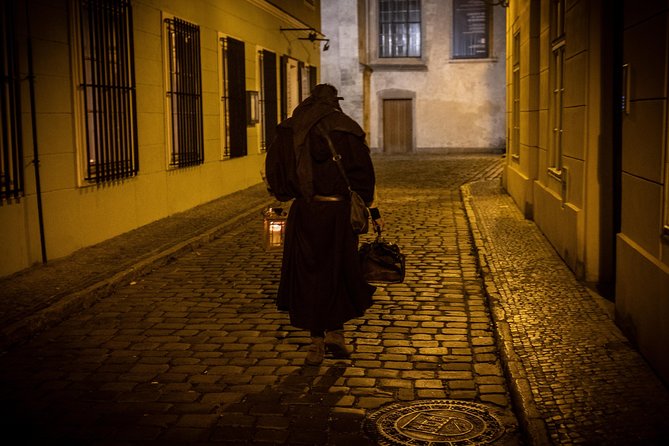
The second stop takes about 10 minutes and brings in the old monastery Klementinum, its library, and the New Town Hall. Here the tour explains different forms of the Black Death and compares how wealthy and poor people in Prague faced the disease.
That contrast gives the walk useful social context. Money could affect where a person lived, how much food could be stored, and whether the family could escape the city. It did not make anyone safe, but it changed the choices available.
Quarantine receives special attention. You hear what isolation meant before modern hospitals, laboratories, or organized public health systems. The subject feels especially accessible because the tour connects official rules with ordinary problems: who stayed behind, how people obtained supplies, and how fear changed behavior.
This is one of the tour’s stronger sections for anyone interested in epidemics, medicine, or public policy. Several guides are praised for research and for explaining the disease in plain language. One guide, David, was described as having prepared by speaking with bacteriologists and epidemic doctors. That background helps keep the material grounded in fact rather than costume drama alone.
Old Town Square, merchants, and wartime Prague
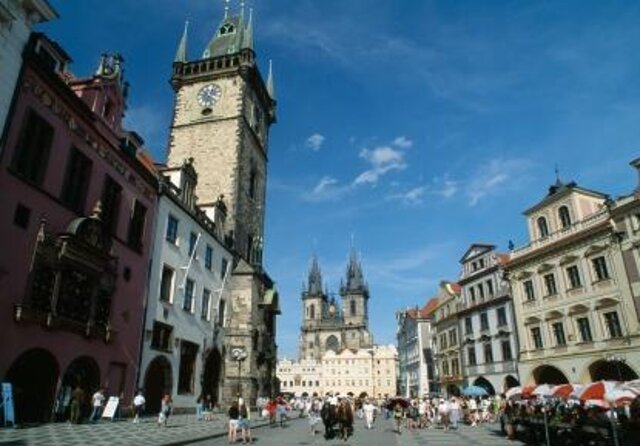
At Staroměstské náměstí, the large Old Town Square, the tour shifts toward commerce and public life. You hear about the Hussite Church, Týn Church, and Old Town Hall while the guide explains how merchants operated during plague years.
The square is a good setting for this part of the story. It was a place of trade, gathering, news, and movement. Disease control could clash with the need to keep goods moving, and merchants had to balance income against exposure. That practical tension makes the subject feel less distant.
The guide also connects plague-era Prague with the 30 Years’ War. This broadens the walk beyond a single outbreak and shows how disease, conflict, religion, and trade could overlap. Still, you should keep your expectations in check. The tour provides an introduction to these subjects, not a full political history of the war or a detailed architectural tour of Old Town Square.
The square may be busy, and city noise can affect how easily you hear every word. The small group size helps, but you should stay close to the guide. Clear delivery is one of the qualities repeatedly praised in guides such as Thomas and David, and it matters in open public spaces.
Franz Kafka, Jewish Prague, and Albert Camus
The stop at the Franz Kafka statue lasts about five minutes. The Kafka introduction is brief, but it provides a bridge into Prague’s Jewish Quarter.
This part of the walk looks at the experience of Jewish people during plague periods in Prague and across Europe. That inclusion matters. Stories about the plague often focus on doctors, rulers, and mass death while leaving out the prejudice and social pressure faced by minority communities. Here, you get a reminder that fear could turn into accusation, exclusion, and persecution.
The tour also introduces Albert Camus’s novel La Peste. The literary reference connects past epidemics with later attempts to make sense of disease, fear, and human behavior. It is a short stop, so do not expect a full discussion of Kafka, Camus, or Jewish Prague. Instead, these names widen the frame and link medical history with culture and memory.
If your main interest is Prague’s Jewish monuments, this walk will not replace a dedicated Jewish Quarter tour. Its focus is how plague affected Jewish communities, not a full visit to synagogues, cemeteries, or museums.
Same city, a completely different afternoon:
- Prague: Castle Tour with Local Guide and Entry Ticket
★ 4.6 · 10,422 reviews - Prague Castle 2.5-Hour Tour Including Admission Ticket
★ 4.7 · 8,927 reviews - Prague: Oldtown, Medieval Underground & Dungeon History Tour
★ 4.2 · 8,244 reviews - Prague: Vltava River Night Cruise with Buffet
★ 4.3 · 7,338 reviews
The old hospital at St. Simon and Jude
The longest stop, about 15 minutes, takes place near the Church of Saint Simon and Jude. You visit the old hospital Na Františku and learn more about plague in Prague, treatment methods, and the medical background of a disease that killed approximately 200 million people worldwide.
This section should appeal most to anyone working in health care or interested in the history of medicine. The guide explains what doctors and caregivers could do, what they misunderstood, and how people tried to respond with the tools available at the time.
The tour also gives attention to lesser-known medical workers who served at the hospital. That choice is welcome. It shifts the story away from famous names and toward the people who faced sick patients directly.
Expect some unsettling material. The subject involves death, fear, ineffective treatments, and old medical practices. The tone, however, is not relentlessly grim. The guides use humor to keep the walk moving, and the balance seems to be one of the experience’s most successful features. It can feel creepy in a good way, especially after dark or in rainy weather, but it remains suitable for a broad age range according to the provided experience details.
You should also know that the tour does not try to turn the plague doctor into a serious medical authority. The costume is a storytelling tool. The value comes from the historical explanation behind it.
St. Agnes Convent provides a quiet ending
The tour ends at the National Gallery Prague’s Convent of St. Agnes, dedicated to Agnes of Bohemia. This final stop lasts about 15 minutes and introduces Agnes’s life and work before pulling the main ideas together.
Ending at a monastery gives the walk a calmer setting after the busy streets and market square. You hear a final account of plague life in Prague and Europe, then learn about the disease’s current status. This last detail helps place the medieval and early modern material in a modern medical context.
A group photograph with the plague doctor closes the experience. It is a small touch, but it gives you a keepsake and lets the costumed performance end on a lighter note.
Pay attention to the route here. The activity ends somewhere different from where it starts. The stated finish is at St. Agnes Convent, and no return to Karlova is included. That is not a problem if you are comfortable continuing from the Old Town, but it matters when planning dinner, transport, or another timed activity.
What the guides do best
The guide makes or breaks a character-led walk, and this experience appears to place strong weight on performance. Thomas is repeatedly described as funny, attentive, and good at bringing the period to life. David is praised for clear explanations, preparation, and a strong sense of humor. Oskar and Oscar are also singled out for articulate delivery and engaging presentations, while Maddie is described as well prepared and personable.
You may not receive one particular guide, so treat those names as examples of the style you can expect rather than a booking guarantee. The shared strengths are more important: humor without constant silliness, clear speech, audience involvement, and the ability to answer extra questions.
That tone works well for families. Children and teenagers can follow a costumed character through the streets, while adults get material on medicine, religion, social class, and public health. One account specifically describes children aged 5, 12, and 16 enjoying the experience, and another says a 10-year-old considered it a favorite activity in Prague.
The material is not designed only for children, though. Adults with an interest in pandemics, medical history, or social history should find plenty to think about. The best guides appear to keep the jokes in service of the subject rather than using humor to avoid it.
Walking effort, group size, and timing
The activity lasts approximately one hour and 30 minutes. The route is described as a pleasant walk that is not too demanding, with one account calling it a good choice after a long day of sightseeing.
Most travelers can participate, and the tour is near public transportation. Service animals are allowed. The group limit is listed as 10 people, which is a useful size for listening to a guide in city streets and for keeping the performance personal.
You should still wear comfortable shoes. The route passes through several central Prague locations and includes alleyways and public squares. No special fitness level is stated, but this is a walking activity rather than a seated show.
The tour is offered in English and uses a mobile ticket. Since the experience depends on good weather, rain or other poor conditions can lead to a different date or a full refund. A rainy evening may add atmosphere, but you should have a weather plan and avoid scheduling it too tightly against another outdoor activity.
The tour is often booked about 16 days ahead. That timing suggests you should reserve early if your Prague dates are fixed, especially because the small group limit may reduce last-minute availability.
Is $26.61 a fair price?
At $26.61 per person, this is not the cheapest free walking option in Prague, but it offers something different. You are paying for a costumed performance, a focused subject, a planned route through several central sites, and a guide who combines storytelling with historical explanation.
The value is strongest if you want an evening activity that mixes entertainment and learning. You see parts of the Old Town while hearing about quarantine, medicine, Jewish life, commerce, and religious beliefs. That is a good amount of material for 90 minutes.
The value is weaker if your main goal is Prague’s architecture. You will pass notable buildings, but the guide’s attention stays on plague-era life. The experience also does not include admission tickets to the churches, museum spaces, or other buildings named along the route. Each stop is an outdoor introduction or nearby visit within the walking program.
A 4.9 rating from 126 reviews and a 98 percent recommendation rate indicate a strong overall response. The praise centers on the same qualities that matter most here: entertaining guides, clear explanations, historical detail, and suitability for mixed-age groups.
There is one specific criticism worth keeping in mind. One person found the costume smelled and needed attention. That sounds like an isolated presentation issue, but it is fair to mention because the costume is part of the attraction.
Who should book the Plague Doctor of Prague?
I would choose this tour if you enjoy history with a theatrical edge. It is especially well suited to people interested in medicine, epidemics, public health, religious beliefs, or the social effects of disease.
It also works for families who want something more unusual than a standard monument tour. The short route, jokes, and costumed guide can hold the attention of younger visitors, while the medical and social material gives adults a reason to join.
Couples and small groups may like it as an evening walk. It offers a different view of Prague after the usual castle, bridge, and square visits, and the group photo gives the outing a playful finish.
I would skip it if you dislike dark subjects, theatrical guides, or stories about death and old medical treatment. I would also look elsewhere if you want a full architectural tour, a long visit inside Jewish Quarter landmarks, or a detailed account of the 30 Years’ War.
Booking is flexible up to 24 hours before the start time, when you can receive a full refund. Cancellations or changes within 24 hours are not refunded, and the operator may offer another date or a refund if poor weather or too few bookings force a cancellation.
FAQ
Where does the Plague Doctor of Prague tour start?
It starts at Aurus Hotel Prague, Karlova 3, 110 00 Praha 1-Staré Město, Czechia.
Where does the tour end?
The tour ends at the National Gallery Prague’s Convent of St. Agnes, at a different location from the starting point.
How long does the experience last?
The walking tour lasts approximately one hour and 30 minutes.
What language is the tour offered in?
The tour is offered in English.
How much does the tour cost?
The listed price is $26.61 per person.
How many people can join the tour?
The activity has a maximum group size of 10 travelers.
Is the tour suitable for most people?
Yes. Most travelers can participate, the route is near public transportation, and service animals are allowed.
Can I cancel for a full refund?
Yes. You must cancel at least 24 hours before the experience start time for a full refund. Cancellations or changes made less than 24 hours before the start time are not refunded.
Should you book it?
Book this tour if you want Prague history told through a memorable character, with enough medical and social detail to make the subject worthwhile. The best reason to go is the balance: guides such as Thomas and David bring humor and energy, but the walk still covers quarantine, Jewish communities, medicine, hospitals, and the beliefs that shaped plague responses.
At $26.61, it is a fair buy for a compact evening experience, particularly for families, medical professionals, history fans, and anyone who has already seen Prague’s main sights. Just remember that this is a plague story set among Prague landmarks, not a full tour of those landmarks themselves.
Just added around Prague
- Prague Highlights 4 Hour Private Walking Tour★ 5.0 · 3 reviews
- VIP Prague Segway Tour Around Monastic Breweries★ 4.0 · 3 reviews
- Private Guided Tour from Prague to UNESCO Kutna Hora★ 5.0 · 3 reviews
- From Prague Day Unique Tour To Cesky Krumlov★ 4.5 · 3 reviews
- Cesky Krumlov: Insta-Perfect Walk with a Local★ 5.0 · 3 reviews
- Prague: WWII Tour with Local Historian SMALL GROUP★ 5.0 · 3 reviews
- Learn Traditional Czech Cooking from Authentic Family Recipes★ 5.0 · 3 reviews
- Prague Tour in Spanish★ 5.0 · 3 reviews